Washington's contemporaries hailed his Revolutionary War victories at Trenton and Yorktown, but they honored him more for risking his fame, fortune and life in taking on military responsibilities for which he wasn't paid—and then giving up command to return to his farm and family. The young American citizenry esteemed him for bringing together and presiding over the Constitutional Convention, but they honored him more for his steadfastness in holding the colonies together and facing down potential insurrectionists who might have seized the government and made him a military dictator. And while they appreciated him returning to public service as president, they honored him more for leaving an office that many expected him to hold for life.

Monday, February 21, 2011
Truly admirable ...
... The Original American Idol.

Wolf Hall
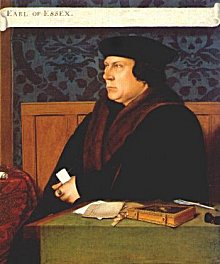
Hilary Mantel's Wolf Hall, which follows the saga of Henry VIII down to the execution of Thomas More in 1535, has been cast in reviews as a novel primarily about Thomas Cromwell, the King's confidant and chief political advisor. Having finished the novel this weekend, I want to challenge this assumption.
It seems to me that while Mantel processes the tumult of Henry's reign through the eyes - and experiences - of Cromwell, the novel is as much about Thomas Wolsey and the Boleyn Clan as it is about Cromwell.
At first, this surprised me: but by the end of the book it seemed clear that Mantel intendedWolf Hall as the first novel in a series of three.
Imagine this: Wolf Hall addresses Wolsey's collapse and Cromwell's rise; the second volume covers Cromwell's demise; and the third chronicles the growth of Edward VI and the controversies swirling around Jane Grey. The trilogy, as it were, ends with the ascent of Mary Tudor in 1553.
What's the point of all this conjecture? Wolf Hall was the name of the Seymour family's principal estate - and this is where Mantel's novel ends: that is, with hints of Anne Boleyn's collapse and even more subtle hints of Jane Seymour's rise.
In some ways, it's odd that Mantel named her novel as she did - for the Seymour Clan does not enter the book, really, until its final hundred and fifty pages. A more apt title might have been Austin Friars, Cromwell's perch from 1527 forward.
To close: I can't imagine that Mantel is done with her work - and I certainly hope she is not, because this novel was an addiction. Hulking, strenuous, insightful: it was all of these things - and more!
Plus, I wanted to add: Mantel's a master of style. Her use of the colon and semi-colon is tremendous. Really, it is. She writes in an organic way, one which perfectly matchs the content of her book.
Hilary Mantel: I may not always love your essays, but this was one great novel. Thank you! (It's not often that I make it through six hundred pages without complaint...)
Thought for the day ...
In a world of prayer, we are all equal in the sense that each of us is a unique person, with a unique perspective on the world, a member of a class of one.- W. H. Auden, born on this date in 1907
Sunday, February 20, 2011
Vintage review ...
... William Carlos Williams On Wallace Stevens. (Hat tip, Dave Lull.)
The language is constrained by the meter instead of there being—an impossible peak it may be—a meter discovering itself in the language.
Powerful endorsement ...
... Ballantine Ale and Hemingway.
I didn't know Hemingway was a fan, but I sure was. Ballantine ale was uniquely tasty. Didn't know it was still available either, but the unique taste disappeared after Schmidt's bought Ballantine.
I didn't know Hemingway was a fan, but I sure was. Ballantine ale was uniquely tasty. Didn't know it was still available either, but the unique taste disappeared after Schmidt's bought Ballantine.
Song and dance ...
Last night Debbie and I went to see the Nichole Canuso Dance Company and The Mural and the Mint perform As the Eyes of the Seahorse. Nichole Canuso and The Mural and the Mint's Michael Kiley are neighbors of ours. Their little son Simon often brightens our day by impromptu visits (a few weeks ago he helped Debbie clear the snow off the deck).
Anyway, we were both very impressed. The Mural and the Mint's refreshingly lyrical rock was finely done, and the dances were consistently compelling (one in particular, performed by two women dancers, had a Patricia Highsmith intensity to it). These two groups are worth keeping an eye on.
The event, by the way, took place in the Maas Building, a former factory in lower Kensington, not far from where my family lived before I was born.
Thought for the day ...
The wish to pray is a prayer in itself. God can ask no more than that of us.- Georges Bernanos, born on this date in 1888
Saturday, February 19, 2011
Meaning vs. information ...
I have bumped this post because I only skimmed the review before I posted it. I have now read it fairly carefully, and plan on reading it yet again. It has much bearing on life as we now live it. It seems, for instance, pertinent to the WikiLeaks business. Talk about the separation of information and knowledge. WikiLeaks provides information. Determining the meaning of that information is something altogether different, and those who think they know more about what is going on in the world simply from the information provided by WikiLeaks are, I believe, deluding themselves.
... Freeman Dyson on How We Know. (Hat tip, Dave Lull.)
Even physics, the most exact and most firmly established branch of science, is still full of mysteries. We do not know how much of Shannon’s theory of information will remain valid when quantum devices replace classical electric circuits as the carriers of information. Quantum devices may be made of single atoms or microscopic magnetic circuits. All that we know for sure is that they can theoretically do certain jobs that are beyond the reach of classical devices. Quantum computing is still an unexplored mystery on the frontier of information theory. Science is the sum total of a great multitude of mysteries. It is an unending argument between a great multitude of voices. It resembles Wikipedia much more than it resembles the Encyclopaedia Britannica.
Incisive Nige ...
... Ball Feels the Heat. (Hat tip, Dave Lull.)
I fins something preternatural about the extent to which Nige and I think alike (of course I could say the dame about Dave).
People without inwardness ...
... The Disneyfication of death. (Hat tip, Dave Lull.)
I am glad that, as Catholic, when I finally get around to shuffling off my mortal coil, I will be spared any "celebration of life" -- a phrase commonly in obituaries these days. I want a requiem Mass, preferably sung, and I hope, as Rimbaud put it in one of his poems, that at least "one prayer shall rise."
Amen, amen ...
... Against interpretation, against allegory, for Kafka.
I enjoy Poe, but any analysis that leads to you plumping for him over Kafka is inherently flawed.
To put it mildly. I also happen to think that Edmund Wilson is somewhat overrated.
We link ...
... you decide:
On the other: A LIBRARIAN REACTS TO “A LIBRARIAN REACTS TO WIKILEAKS.”
On the one hand: A LIBRARIAN REACTS TO WIKILEAKS.
(Hat tip, Lee Lowe.)
Re-situating origins ...
... Handing Out Knives to Madmen.
The charge brought against Socrates, by a team of voluntary prosecutors, was impiety—they accused him of impropriety in respect to the gods and corruption of the youth. I would suggest that Socrates was convicted not because the jurors were religious fanatics, not because they had lost their democratic tolerance, but because he seemed to them unreasonably unwilling to take responsibility for what he said in public. Today we allow pundits to say what they please, even if their speech has pernicious or even fatal effects. I think we are right to do so, and I think that 280 (out of 501) Athenian jurymen were wrong when they voted to condemn Socrates. But I think they were right to believe that when prominent public figures refuse to take personal responsibility for the consequences of their speech, democracy is in grave danger.
Class conflict ...
... Why 'King's Speech' Leaves Me Stuttering. (Hat tip, Dave Lull.)
I haven't seen The King's Speech, though I intend to. Debbie has seen it, and thought it was wonderful. I have seen the new version of True Grit, and it's OK, but it lacks the joie de vivre of the original. Oh, I know the new one is supposed to be truer to Charles Portis's novel. But being faithful to novels is not what the films based on novels are supposed to be about. If you want fidelity to the novel, read the novel. A film is an independent work of art and should be judged on its own terms, not the terms of the work on which it is based. Hitchcock's Strangers on a Train is far from faithful to Patricia Highsmith's novel, but it is one of Hitchcock's best films. The new True Grit seems longer than it is, because it is slower than it needs to be. The real difference between the new version and the original is a matter of tempo, and the original's tempo is better.
Thought for the day ...
You can reconstruct the picture from chaos and memory's ruins.- Kay Boyle, born on this date in 1902
Friday, February 18, 2011
Much in what he says ...
... Reading is overrated. (Hat tip, Dave Lull.)
The difference between pain and pleasure is that the former overwhelms the latter, but no amount of white truffles, operatic arias or sex will drive away the agony of a bad toothache, much less the pain of the death of a loved one. And a good book certainly won't get close. Why claim that it might, or can?
Fine, fine theater ...
Last night, Debbie and I went to the Arden Theatre's production of Eugene O'Neill's A Moon for the Misbegotten, which Terry Teachout wrote about here: I'd rather be in Philadelphia. Everything Terry says is correct. If you live in these parts, or plan to visit anytime soon, try to go. It's a beautiful rendering of a play that is both funny and deeply touching, and it closes February 27.
Thought for the day ...
Writers are frequently asked why they wrote their first book. A more interesting answer might come from asking them why they wrote their second one.- Len Deighton, born on this date in 1929
Thursday, February 17, 2011
A New Literary Journal
Introducing: The Common. Quite an advisory board...(And guess what? It'll be in print!)
Here we go again ...
... God and Gossip. (Hat tip, Dave Lull.)
Conservative and reactionary critics of science have often accused it of dehumanizing us. They will be delighted to learn that Bering, who clearly implies that we would be better off if we were to follow the lead of our evolutionary cousins and begin shamelessly shitting on ourselves in public, has made their case for them. But perhaps this is unfair. (Why, though, should I care about fairness, which is no doubt the product of an adaptive illusion?)
And the winners were ...
... Celebrating 61 Years of National Book Awards Poetry. (Hat tip, Dave Lull.)
Something new to me ...
... and maybe you, too: They Were Found Wanting (The Transylvanian Trilogy, Book 2).
This week's batch ...
... of TLS Letters: Swift and colonialism, Chinese archives, Honeybees, and more!
Thought for the day ...
Stillness is tranquility of the inner life, the quiet at the depths of its hidden stream. Stillness is a collected, total presence, a being all there, receptive, alert, ready.-Romano Guardini, born on this date in 1885
Wednesday, February 16, 2011
Q & A ...
... Travels in China: An Interview with Dr. Paula Cohen.
I know Paula. She used to review for me. She is one the smartest people I know. She's good-looking, too. And while I'm at it, let me plug her latest novel, What Alice Knew. I loved it. But what is most interesting is that Debbie couldn't put it down.
So you think you got problems ...
... well, consider this: Sentencing Guidelines: Stanley Fish’s How to Write a Sentence. (Hat tip, Dave Lull.)
The quality of doubt ...
... Tennyson and the real Arthur Hallam.
...Hallam’s main benefit to mankind was through his posthumous influence. Not only was he the moving force behind In Memoriam, but the rest of his social circle could find comfort in rewriting his story as a tragedy of unfulfilled promise. For friends like Gladstone, his death may even have been something of a relief. Having spent the previous few years mourning a friendship that faded after Hallam left Eton for Cambridge, there was now nothing to prevent him from polishing up his memories like jewels.
A better man ...
... The Recognition of Fr. Damien.
... it is precisely the single-minded devotion to their mission and to those in their charge which make saints so difficult to appreciate by those of us who are “more balanced”.
News from the wasteland ...
... Post-Prosperity II: Why Everybody Watched Bishop Sheen. (Hat tip, Dave Lull.)
The 1950s, so maligned by ignorant generations who didn’t live it, gave us the best picture of the contradictions the ambiguous idea of prosperity offered the world, perhaps in the history of what we still call Western Civilization. Progressives hated the decade ...
Thought for the day ...
Absolute liberty is absence of restraint; responsibility is restraint; therefore, the ideally free individual is responsible to himself.Henry Adams, born on this date in 1838
Tuesday, February 15, 2011
How can this be?
... Alfred North Whitehead: An Ignored Sesquicentennial. (Hat tip, Dave Lull.)
Typical. Whitehead was a vastly deeper thinker than his rather light-weight (as far as philosophy is concerned) sometime collaborator Bertrand Russell. So naturally, he has been forgotten, while other light-weights, such as Richard Dawkins, keep the memory of Russell alive
Somewhat good news ...
... Experts determine age of book 'nobody can read'. (Hat tip, Dave Lull.)
My own personal theory is that it was written by an evolutionary predecessor of Richard Dawkins.
Turn and turnabout ...
... Radical Transparency: A tell-all memoir offers unflattering details about Julian Assange and his tell-all organization.
If Mr. Assange emerges from the pages on "Inside WikiLeaks" as a fairly ghastly human being, Mr. Domscheit-Berg does not come out looking much better. Apart from his own acknowledged dishonesty as the organization's spokesman, he still shares his former idol's toxic political views. He proudly calls WikiLeaks the "world's most dangerous website" and recently launched his own Assange-free version, called OpenLeaks.
Priceless ...
... Digested read: Bird Cloud by Annie Proulx.
It was also hard to find the right craftsmen. We tried Idle Ian and Bodger Brian, but it was clear when they arrived on site five minutes late that they were not up to my exacting standards. Eventually, Kevin found Patronised Pete and Put-Upon Paul, and the build got under way in late 2005. I had to go away to Capri for the winter and didn't return to Bird Cloud until the following spring. I was horrified. Not only were the tatami prayer mats made of unsustainable rice-straw, but the window in my bedroom had been positioned three inches too far to the left and my view of the eagle's nest was blocked by the cliff. It took three tonnes of dynamite and several hundred thousand dollars to rectify that problem.
Going the distance ...
... Why do some artists seem to fade away while others last forever? (Hat tip, Dave Lull.)
Personally, I was most deeply affected by the letter John Updike writes in response to questions put to him by Delbanco. Delbanco wants to know how Updike's work habits have changed since his early days as a writing "apprentice." He wants to know if Updike's goals have been redefined. He wants to know, finally, if Updike himself had written about lastingness in some oblique or overt way. Updike's response is both eloquent and tactical, reminding us that ultimately it's the daily details that matter most - the discipline of the artistic endeavor, the motivating ideal (again and again) of a finished work, the refined understanding of what true art is:"By and large what lasts best is the most concrete, the most actual, delivering to the reader a piece of earth and humanity. Aesthetic flourishes fade and wrinkle, though they may get attention when new. A blunt sincerity outlasts finely honed irony, I would think. An ability to see over the heads of important contemporary issues into the simple truth of daily life is what we can respond to a century later."
Indeed ...
... Journalists—Stop Pretending To Be Unbiased.
It is indeed true that we all have biases. But having been a journalist, I think I can say that it is possible to be impartial. In fact, that is the fun of being a reporter if a reporter is what you want to be. Some years ago, when I wrote for The Inquirer's religion page, I wrote a story about a woman who had written to tell us that she had seen angels. I paid her a visit, heard what she had to say, and passed it along to readers. Not long after the story appeared, I received a letter from her thanking me profusely ... for just reporting what she said. Seems all of her friends had been telling her that she should never have spoken to a reporter, that all I was going to do was make fun of her. The thought of doing that never crossed my mind. My job, as I saw it, was to report her experience, not pass judgment on it. After all, one of my biases is that experience trumps all theories. Who was I, who was anyone, to say she had not experienced what she claimed to have?
Thought for the day ...
Familiar things happen, and mankind does not bother about them. It requires a very unusual mind to undertake the analysis of the obvious.- Alfred North Whitehead, born on this date in 1861
Monday, February 14, 2011
Where do they find people ...
... like the reporter of this piece? Conservatives queue up for peek at 'Atlas Shrugged' at CPAC. (Hat tip, Dave Lull.)
Once upon a time I gave a lecture at Rockford College on Albert Jay Nock. In the audience was a large contingent of Randians (also a large contingent of Rothbardians). Both groups proved difficult to have a conversation with, because both were comprised of true believers. At any rate, though CPAC calls itself "conservative," the fact that Ron Paul was the big winner t its powwow indicates it was dominated by libertarians. Which is OK by me. I'm a registered Libertarian. On the other hand, I think Ron Paul, though he is sometimes on the mark, is also something of a flake. Conservatives and libertarians agree on some things, but there are also salient differences between the two groups. Ms. Hesse seems oblivious to these and all other pertinent distinctions.
This should cheer the pols ...
... and kindred parasites: How to crash the Internet. (Hat tip, Dave Lull.)
Subscribe to:
Posts (Atom)