
Tuesday, August 30, 2005
Something completely different ...
Now here's a thoroughly and comprehensively contrarian view: Czech President Vaclav Klaus speech at the Regional Meeting of the Mont Pelerin Society in Rekjavik (thanks to Glenn Reynolds). For those unfamiliar with the work of Nobel Prize-winner Friedrich Hayek, a good place to start familiarizing yourself is The Road to Serfdom.

Monday, August 29, 2005
Worth considering ....
Allen Thorpe has some interesting thoughts about science and intelligent design.
Back to blogging ...
I am finally able to resume blogging. Since photographer Eric Mencher and I headed upstate to do some reporting, my time has had to be budgeted carefully. Eric and I put in two 15-hour days on the road. And when you’re reporting on the road, the only time you really aren’t working is when you finally get to sleep.
When we got back I had to do everything that was left undone while I was away — move reviews to the copy desk, pitch in to do some of the things vacationing colleagues would have done, go through stacks of books that had arrived, check email and snail mail, as well as start figuring out how to write up what Eric and I had been reporting on.
It is my view that punditry has lately assumed a greater importance in journalism than it deserves. I prefer reporting, which is a lot harder to do than people think. In a wonderful book called The Memoirs of a Superfluous Man, Albert Jay Nock tells of a college president who had devised an interesting test for his incoming freshman: He would give them a paragraph of standard English prose. He would ask them to read it to themselves, then read it aloud, and finally study it carefully for a few moments. Then he would ask them to write down in their own words what it said. Nine out of 10 would fail. They would write what they thought it meant, or what it reminded them of, or whatever. But they would not or could not simply repeat the gist of it in their own words. In Nock’s view this meant that they were literate, but could not read.
I mention this because, when I was in college and thought that one of the things I would like to do after I graduated was literary journalism, I often pondered how one could do that creatively — because, like probably every young person, I wanted to be creative, to place my distinctive stamp on whatever it was I did. I have since come to realize that one of the most difficult things to do when it comes to reviewing a book is to accurately report what the book is about.
I had, for all practical purposes, a double major in college. I went to a Jesuit school, which at the time was still adhering to the educational guidelines established in 1599 by Claudio Aquaviva, the fifth general of the order. This meant two years of scholastic philosophy — logic, epistemology, metaphysics, ethics, and rational psychology. I was interested in philosophy and took extra courses: the history of philosophy, a course in existentialism and another in aesthetics. One of my teachers, Edward Gannon, S.J., had got his Ph.D. at the University of Louvain in Belgium, back when everything there was done in Latin (for all I know, it still is). Father Gannon was a brilliant teacher, the most important teacher in my life. He taught the courses in logic, epistemology and metaphysics (he also taught the existentialism and aesthetics courses). His textbook for the epistemology course was William Luipen’s Existential Phenomenology. And that is what I ended up being schooled in: a Thomistically grounded existential phenomenology.
Among other things, I learned a most important lesson: If one accurately and precisely describes what one experiences, how one feels about that experience will become perfectly clear. You don’t have to go on and on making evaluative pronouncements, raising or lowering one’s critical thumbs for all to see.
A couple of weeks ago, my colleague Michael Rozansky and I were chatting about book reviews. Michael said that he was often led to read a book even if a review of it wasn’t entirely positive. I pointed out that a good reviewer always provides sufficient information for the reader of the review to place the reviewer’s opinion in context. Another colleague of mine, Karen Heller, wrote a rave review of Jonathan Franzen’s The Corrections that absolutely convinced me I would never want to read it. I’m sure the book has many merits. I just don’t think it’s a book for me.
Smart reviewers are above all informative. Smart readers of reviews focus on the information, not the evaluation.
When we got back I had to do everything that was left undone while I was away — move reviews to the copy desk, pitch in to do some of the things vacationing colleagues would have done, go through stacks of books that had arrived, check email and snail mail, as well as start figuring out how to write up what Eric and I had been reporting on.
It is my view that punditry has lately assumed a greater importance in journalism than it deserves. I prefer reporting, which is a lot harder to do than people think. In a wonderful book called The Memoirs of a Superfluous Man, Albert Jay Nock tells of a college president who had devised an interesting test for his incoming freshman: He would give them a paragraph of standard English prose. He would ask them to read it to themselves, then read it aloud, and finally study it carefully for a few moments. Then he would ask them to write down in their own words what it said. Nine out of 10 would fail. They would write what they thought it meant, or what it reminded them of, or whatever. But they would not or could not simply repeat the gist of it in their own words. In Nock’s view this meant that they were literate, but could not read.
I mention this because, when I was in college and thought that one of the things I would like to do after I graduated was literary journalism, I often pondered how one could do that creatively — because, like probably every young person, I wanted to be creative, to place my distinctive stamp on whatever it was I did. I have since come to realize that one of the most difficult things to do when it comes to reviewing a book is to accurately report what the book is about.
I had, for all practical purposes, a double major in college. I went to a Jesuit school, which at the time was still adhering to the educational guidelines established in 1599 by Claudio Aquaviva, the fifth general of the order. This meant two years of scholastic philosophy — logic, epistemology, metaphysics, ethics, and rational psychology. I was interested in philosophy and took extra courses: the history of philosophy, a course in existentialism and another in aesthetics. One of my teachers, Edward Gannon, S.J., had got his Ph.D. at the University of Louvain in Belgium, back when everything there was done in Latin (for all I know, it still is). Father Gannon was a brilliant teacher, the most important teacher in my life. He taught the courses in logic, epistemology and metaphysics (he also taught the existentialism and aesthetics courses). His textbook for the epistemology course was William Luipen’s Existential Phenomenology. And that is what I ended up being schooled in: a Thomistically grounded existential phenomenology.
Among other things, I learned a most important lesson: If one accurately and precisely describes what one experiences, how one feels about that experience will become perfectly clear. You don’t have to go on and on making evaluative pronouncements, raising or lowering one’s critical thumbs for all to see.
A couple of weeks ago, my colleague Michael Rozansky and I were chatting about book reviews. Michael said that he was often led to read a book even if a review of it wasn’t entirely positive. I pointed out that a good reviewer always provides sufficient information for the reader of the review to place the reviewer’s opinion in context. Another colleague of mine, Karen Heller, wrote a rave review of Jonathan Franzen’s The Corrections that absolutely convinced me I would never want to read it. I’m sure the book has many merits. I just don’t think it’s a book for me.
Smart reviewers are above all informative. Smart readers of reviews focus on the information, not the evaluation.
Monday, August 22, 2005
Vacation Days (Conclusion)
I probably won't be blogging again until Thursday. Tomorrow morning, photographer Eric Mencher and I will be taking off for Tunkhannock to do some reporting on the art scene I've blogged about. One stop I haven't mentioned is the Springville Shoolhouse Art Studios in Springville, which is in Susquehanna County, the one immediately north of Wyoming, where Tunkhannock is. The Springville Schoolhouse Art Studios is a work in progress. For 31 years, from 1925 to 1956, the building housed the Springville village schoolhouse (grades one through 12). It's now owned by painter James Penedos and sculptor Charles Welles, and James and his brother Carlos -- especially his brother Carlos -- are renovating and restoring the building, turning it into art studios. The first and second floors already have a variety of live-in studio workshop spaces, ranging from 300 to 900 square feet with 12-foot ceilings. Each studio has a private bathroom, kitchen and sleeping loft. Each also has a high-speed Internet connection. A perfect vacation spot for the artistically inclined. You can read more about it here.
Later.
Later.


Sunday, August 21, 2005
A mine of information ...
On this date in 1920 Christopher Robin Milne, the model for his father A.A. Milne's tales of Winnie the Pooh, was born. And yesterday was the date in 1667 when John Milton's Paradise Lost was entered in the Stationers' Register. I know all this because I subscribe to Today in Literature. It only costs $20 a year and is a wonderful way of putting the world of literature into temporal perspective. Check it out.
Gonzo farewell ...
Fans of the late Hunter S. Thompson will find this item, from the Aspen Daily News, of interest. (Thanks to Dave Lull for alerting me to faulty link.)
Choosing a book for review ...
I gave myself a break from blogging for a few days in order to clear my brain. The past week was pretty hectic, what with several colleagues on vacation and the rest of us having to take up the slack to make sure stories moved more or less on time. I also spent a good bit of time finally restoring to the book room and my desk. Next come the emails, which have again climeed to more than 500.
One main point of this blog is to give readers some idea of how one goes about being a book review editor. So I thought I'd tell how I came to be reading the book I'm planning to review on Sept. 18.
(I won't have a review on Sept. 4, because it's due this week, and I'm going to be on assignment for a couple of days this week. Good reason to give myself a week off. Which becomes two weeks, actually, because Sept. 11 is the fall preview issue. As for Aug. 28, that review moved last week.)
I had been reading, and planning to review, Missing Person by Patrick Modiano. This actually won the Prix Goncourt after it was first published in 1978. It's only 168 pages long, but I found it slow going. Not because there was anything difficult about it. It just wasn't very engaging. It reminded me of something Mark Twain said about a Henry James novel: Once you put this book down, you just can't pick it up again.
The missing person of Modiano's title is the narrator, "Guy Roland." I put the name in quotes because he's an amnesiac and doesn't know his real name. Guy Roland is the name on the papers his former employer, a private detective named Hutte, has acquired for him.
He has worked for Hutte for 10 years, but Hutte has just retired. So Guy decides to find out who he really is. That a person would wait 10 years while working for a private eye to search out his missing identity struck me as more than a little implausible. I also found it odd that everybody Guy goes to inquire of isn't the least suspicious or reticent. They invite him into their apartments, give him documents and photos. I got to about 40 pages from the end and he still hadn't found out who he was, but it was looking like he might be from South America (no word on whether he speaks French with an accent).
Then I got an email from physician John Cohn. Dr. Cohn told me that on a recent flight he found himself talking to a local business man named Thomas Quinn who it turned out had just published a novel called The Lion of St. Mark. Dr. Cohn had just finished reading it and said (Dr. Cohn has graciously allowed me to quote his email) that "his story of a democratic republic (Venice) built on sea trade and protected both by oceans and the voluntary service of its citizen soldiers, threatened by a brutal Islamic leader determined to conquer the Christian world, contained striking parallels to our own time. Covering the period surrounding the fall of Constantinople and subsequent decades, the book is, at a minimum, not afraid to challenge political correctness and identify just who it thinks the enemy really is."
This intrigued me for a couple of reasons, one of which is that, since becoming book editor, I seem to have reviewed an unusual number of books set in Venice (though actually, only four). Another, of course, is that The Lion of St. Mark sounded potentially more interesting than Missing Person. So I looked on the shelves of the book room, found Thomas Quinn's book and gave it a look. It was definitely more interesting than Modiano's. Interestingly, this is Quinn's first novel and it is the first installment of a trilogy. Which means that Quinn has managed to land a three-book deal with Thomas Dunne Books, an imprint of St. Martin's Press. That itself is impressive.
I won't say any more about the book now, since I haven't finished it, and I need the material for my review. But that is how one book has come to be reviewed. Thank you, Dr. Cohn
One main point of this blog is to give readers some idea of how one goes about being a book review editor. So I thought I'd tell how I came to be reading the book I'm planning to review on Sept. 18.
(I won't have a review on Sept. 4, because it's due this week, and I'm going to be on assignment for a couple of days this week. Good reason to give myself a week off. Which becomes two weeks, actually, because Sept. 11 is the fall preview issue. As for Aug. 28, that review moved last week.)
I had been reading, and planning to review, Missing Person by Patrick Modiano. This actually won the Prix Goncourt after it was first published in 1978. It's only 168 pages long, but I found it slow going. Not because there was anything difficult about it. It just wasn't very engaging. It reminded me of something Mark Twain said about a Henry James novel: Once you put this book down, you just can't pick it up again.
The missing person of Modiano's title is the narrator, "Guy Roland." I put the name in quotes because he's an amnesiac and doesn't know his real name. Guy Roland is the name on the papers his former employer, a private detective named Hutte, has acquired for him.
He has worked for Hutte for 10 years, but Hutte has just retired. So Guy decides to find out who he really is. That a person would wait 10 years while working for a private eye to search out his missing identity struck me as more than a little implausible. I also found it odd that everybody Guy goes to inquire of isn't the least suspicious or reticent. They invite him into their apartments, give him documents and photos. I got to about 40 pages from the end and he still hadn't found out who he was, but it was looking like he might be from South America (no word on whether he speaks French with an accent).
Then I got an email from physician John Cohn. Dr. Cohn told me that on a recent flight he found himself talking to a local business man named Thomas Quinn who it turned out had just published a novel called The Lion of St. Mark. Dr. Cohn had just finished reading it and said (Dr. Cohn has graciously allowed me to quote his email) that "his story of a democratic republic (Venice) built on sea trade and protected both by oceans and the voluntary service of its citizen soldiers, threatened by a brutal Islamic leader determined to conquer the Christian world, contained striking parallels to our own time. Covering the period surrounding the fall of Constantinople and subsequent decades, the book is, at a minimum, not afraid to challenge political correctness and identify just who it thinks the enemy really is."
This intrigued me for a couple of reasons, one of which is that, since becoming book editor, I seem to have reviewed an unusual number of books set in Venice (though actually, only four). Another, of course, is that The Lion of St. Mark sounded potentially more interesting than Missing Person. So I looked on the shelves of the book room, found Thomas Quinn's book and gave it a look. It was definitely more interesting than Modiano's. Interestingly, this is Quinn's first novel and it is the first installment of a trilogy. Which means that Quinn has managed to land a three-book deal with Thomas Dunne Books, an imprint of St. Martin's Press. That itself is impressive.
I won't say any more about the book now, since I haven't finished it, and I need the material for my review. But that is how one book has come to be reviewed. Thank you, Dr. Cohn
Wednesday, August 17, 2005
On bad poetry ...
Tomorrow (Aug.18) is, I gather, Bad Poetry Day. Seamus Cooney has even compiled an index of Bad Poetry.
Edgar Guest has his defenders and Cooney let's the reader decide about Wordsworth's "The Thorn." (Wordsworth's genuinely great poetry comprises a relatively slender selection of his vast production.) But The Great McGonagall surely has a strong claim to the title of worst poet ever.
Cooney. however, fails to mention at all the incomparable J. Gordon Coogler, immortalized by H.L. Mencken in The Sahara of the Bozart.
A lot of people would class Robert W. Service as a bad poet. But in 1918, Service's Rhymes of a Red Cross Man topped the general nonfiction best-seller list. That's right. It was No. 1.
Service and Guest were popular poets. They put into rhyme and meter ordinary sentiments and experiences. I suspect they are undeserving of the scorn so frequently heaped upon them.
We could use some genuinely popular poets. Probably the last was Stephen Vincent Benet. Imagine: A poet delivering radio broadcasts, writing screenplays and radio shows. And a two-time Pulitzer Prize-winner to boot. His books sold well, too.
Edgar Guest has his defenders and Cooney let's the reader decide about Wordsworth's "The Thorn." (Wordsworth's genuinely great poetry comprises a relatively slender selection of his vast production.) But The Great McGonagall surely has a strong claim to the title of worst poet ever.
Cooney. however, fails to mention at all the incomparable J. Gordon Coogler, immortalized by H.L. Mencken in The Sahara of the Bozart.
A lot of people would class Robert W. Service as a bad poet. But in 1918, Service's Rhymes of a Red Cross Man topped the general nonfiction best-seller list. That's right. It was No. 1.
Service and Guest were popular poets. They put into rhyme and meter ordinary sentiments and experiences. I suspect they are undeserving of the scorn so frequently heaped upon them.
We could use some genuinely popular poets. Probably the last was Stephen Vincent Benet. Imagine: A poet delivering radio broadcasts, writing screenplays and radio shows. And a two-time Pulitzer Prize-winner to boot. His books sold well, too.
Tuesday, August 16, 2005
Check these folks out ...
If you haven't become acquainted with Rus Bowden's Poetry and Poets in Rags column, featured on the Interboard Poetry Community, you should.
The past revisited (again) ...
My post last week, In search of literary thrills past, generated some interesting comments. BradyDale suggested that books that thrilled us once "often don't stand up to the test of time." But Meg said that "books read in your youth shouldn't stand the test of time. If they do, you haven't grown."
I have been thinking about this and I wonder if it's just that certain experiences, including reading experiences, are so uniquely intense, due to time, place, and circumstance, that you just can't hope to repeat them. No kiss, however passionate, is ever like the first kiss.Yet we have a tendency to want to experience things again, to have a thrill long past once more, if only for a moment. And it can't be done. We must move on.
I still intend to reread Alain-Fournier'sThe Wanderer during the week I plan to take off in October -- the week of my next birthday. That's what journalists are for.
I have been thinking about this and I wonder if it's just that certain experiences, including reading experiences, are so uniquely intense, due to time, place, and circumstance, that you just can't hope to repeat them. No kiss, however passionate, is ever like the first kiss.Yet we have a tendency to want to experience things again, to have a thrill long past once more, if only for a moment. And it can't be done. We must move on.
I still intend to reread Alain-Fournier'sThe Wanderer during the week I plan to take off in October -- the week of my next birthday. That's what journalists are for.
Sunday, August 14, 2005
Exploring the mind ...
Michel de Montaigne is generally regarded as the inventor of the personal essay. But it has always seemed to me that few essays written since Montaigne have actually been modeled on the kind he wrote.
Montaigne wrote essays in order to examine the contents of his consciousness by following his trains of thought to wherever they led. Sometimes, they didn’t lead anywhere — which is often the case with trains of thought.
But the essay almost immediately became a vehicle of style, the substance of what was said increasingly subordinate to the manner in which it was said.
Not that Montaigne lacked style. His prose is as natural and unaffected as good plain talk. But his style was simply a reflection of his method: a plain and simple examination of what he thought about whatever.
He started out modestly enough by ruminating over favorite quotes from favorite authors. Two favorite quotes of mine I am sure would have met with his approval. The first is what Hamlet tells Horatio, that “there are more things in heaven and earth … than are dreamt of in your philosophy.” And the other is attributed to Thomas Aquinas, that “all things run into mystery.”
I think these would have met with Montaigne’s approval because I think they pretty much sum up his outlook.
Much has been made of Montaigne’s skepticism, but I think the point of that skepticism is often missed or overlooked. Montaigne was profoundly doubtful that human reason was capable of figuring it all out. Montaigne’s Catholic piety was not feigned. I am sure he found the excesses of belief on both sides of the Protestant/Catholic divide in his time deplorable. But, like Erasmus, he was unwilling to take apart a structure of faith it had taken centuries to build simply because some individuals had come up with some new ideas and arguments.
Montaigne’s skepticism was deeply conservative. He would have agreed with Lord Falkland, that “when it is not necessary to change, it is necessary not to change.”
Montaigne wrote essays in order to examine the contents of his consciousness by following his trains of thought to wherever they led. Sometimes, they didn’t lead anywhere — which is often the case with trains of thought.
But the essay almost immediately became a vehicle of style, the substance of what was said increasingly subordinate to the manner in which it was said.
Not that Montaigne lacked style. His prose is as natural and unaffected as good plain talk. But his style was simply a reflection of his method: a plain and simple examination of what he thought about whatever.
He started out modestly enough by ruminating over favorite quotes from favorite authors. Two favorite quotes of mine I am sure would have met with his approval. The first is what Hamlet tells Horatio, that “there are more things in heaven and earth … than are dreamt of in your philosophy.” And the other is attributed to Thomas Aquinas, that “all things run into mystery.”
I think these would have met with Montaigne’s approval because I think they pretty much sum up his outlook.
Much has been made of Montaigne’s skepticism, but I think the point of that skepticism is often missed or overlooked. Montaigne was profoundly doubtful that human reason was capable of figuring it all out. Montaigne’s Catholic piety was not feigned. I am sure he found the excesses of belief on both sides of the Protestant/Catholic divide in his time deplorable. But, like Erasmus, he was unwilling to take apart a structure of faith it had taken centuries to build simply because some individuals had come up with some new ideas and arguments.
Montaigne’s skepticism was deeply conservative. He would have agreed with Lord Falkland, that “when it is not necessary to change, it is necessary not to change.”
California, here you are ...
Check out the California Literary Review, which now originates in Phoenixville. Lots of interesting stuff.
Wednesday, August 10, 2005
Panning for gold ...
Sam Jones at The Litblog Co-op has some interesting and useful thoughts on how to ferret out lesser known worthwhile authors.
Tuesday, August 09, 2005
In search of literary thrills past ...
Henry Miller writes somewhere -- I think it may in The Books in My Life -- that when, as a young man, he read Thomas Mann's The Magic Mountain, he was enthralled, but that, when he tried to read it again years later, he couldn't get into it and wondered what about it had ever appealed to him.
Re-reading a book that had an especially strong impact at a particular time in one's life may be a dangerous proposition. I'll find out in October, when I'm taking a week off, and plan on re-reading Alain-Fournier's The Wanderer (Le grand Meaulnes). It's a book that has for years occupied a magical spot in my memory, but my wife read it while we were on vacation recently and was, shall we say, underwhelmed. She found it charming, but too vague and misty for her tastes.
I think it's a book likely to appeal to a man rather than a woman -- and a youth rather than an adult -- and a romantic, dreamy youth at that.
At any rate, I am going to from time to time revisit books that meant much to me in times past and report in my column on the results. Perhaps I will simply rid myself of the few illusions I have left.
Re-reading a book that had an especially strong impact at a particular time in one's life may be a dangerous proposition. I'll find out in October, when I'm taking a week off, and plan on re-reading Alain-Fournier's The Wanderer (Le grand Meaulnes). It's a book that has for years occupied a magical spot in my memory, but my wife read it while we were on vacation recently and was, shall we say, underwhelmed. She found it charming, but too vague and misty for her tastes.
I think it's a book likely to appeal to a man rather than a woman -- and a youth rather than an adult -- and a romantic, dreamy youth at that.
At any rate, I am going to from time to time revisit books that meant much to me in times past and report in my column on the results. Perhaps I will simply rid myself of the few illusions I have left.
Monday, August 08, 2005
In search of lost authors ...
It has been estimated that 99 percent of all the books ever published are out of print. Certainly, enough people want to read out-of-print books to make for a thriving second-hand book business.
A couple of Sundays ago I wrote about a book that's out of print: John O'Hara's Sermons and Soda-Water. I was surprised at how many people sent me emails about O'Hara and what I had to say about him.
It had occurred to me, while I was reading O'Hara during my vacation, that it would be interesting to read just the Gibbsville stories, to see how they relate to one another -- and whether they form a cohesive whole. Well, Matthew Bruccoli has put together a collection of the Gibbsville stories called Gibbsville, Pa. I just got a copy from Amazon, along with a copy of BUtterfield 8. I plan on reading them and maybe a couple of the novels and writing about O'Hara again.
The response to my column about O'Hara encourages me to continue writing from time to time about books no longer in print, and about neglected authors. Aficionados of used-book stores are just the sort of people to have favorite neglected writers. So if any of you read this, let me know about them.
Again, I am convinced that the literary blogosphere can bring about a seismic change in critical outlook. We just have to get the conversation going.
A couple of Sundays ago I wrote about a book that's out of print: John O'Hara's Sermons and Soda-Water. I was surprised at how many people sent me emails about O'Hara and what I had to say about him.
It had occurred to me, while I was reading O'Hara during my vacation, that it would be interesting to read just the Gibbsville stories, to see how they relate to one another -- and whether they form a cohesive whole. Well, Matthew Bruccoli has put together a collection of the Gibbsville stories called Gibbsville, Pa. I just got a copy from Amazon, along with a copy of BUtterfield 8. I plan on reading them and maybe a couple of the novels and writing about O'Hara again.
The response to my column about O'Hara encourages me to continue writing from time to time about books no longer in print, and about neglected authors. Aficionados of used-book stores are just the sort of people to have favorite neglected writers. So if any of you read this, let me know about them.
Again, I am convinced that the literary blogosphere can bring about a seismic change in critical outlook. We just have to get the conversation going.
Saturday, August 06, 2005
A liitle bit of fact-checking ...
Thanks to President Bush, evolution is back in the news. The President is being widely portrayed as the living embodiment of Matthew Harrison Brady, the caricature of William Jennings Bryan in Jerome Lawrence and Robert E. Lee's play Inherit the Wind, which is about the so-called Scopes Monkey Trial. Thanks to the Information Age we are blessed to be living in, it is possible to get a quick, factual overview of what actually took place in a Dayton, Tenn., courtroom in July 1925. Included are links to H.L. Mencken's columns and to much else besides. I thought it particularly interesting to learn that Bryan offered to pay the fine that court imposed on John Scopes.
Friday, August 05, 2005
A favorite poet ...
Poet Conrad Aiken, one of my all-time favorites, was born on Aug. 5, 1889. A selection of his poems can be found here. I particularly commend to your attention "Morning Song of Senlin." But there's a special place in my heart for this one.
Thursday, August 04, 2005
Sic transit gloria mundi ...
That is oratory, the professor said uncontradicted.
Gone with the wind. Hosts at Mullaghmast and Tara of the kings. Miles of ears of porches. The tribune's words, howled and scattered to the four winds. A people sheltered within his voice. Dead noise. Akasic records of all that ever anywhere wherever was. Love and laud him: me no more.
This is from Chapter 7 of Joyce's Ulysses. I quote it because of the phrase "Gone with the wind." Joyce obviously wasn't thinking of Margaret Mitchell's novel, which hadn't been written yet, and probably wouldn't have even it had been. And Margaret Mitchell certainly did not take her title from Joyce. Joyce got the phrase, I am sure, from the same place Mitchell got it: Ernest Dowson's poem ">"Non Sum Qualis Eram Bonae Sub Regno Cynarae":
I have forgot much, Cynara! gone with the wind,
Flung roses, roses riotously with the throng ...
Dowson was a cutting-edge poet when Joyce was growing up. He was probably one of Joyce's early favorites. His poetry lives today in two titles. Mitchell's novel is one.
The other is taken from another poem, "Vitae Summa Brevis Spem Nos Vetat Incohare Longam" -- "They are not long, the days of wine and roses."
Such are the vagaries of literary celebrity.
Gone with the wind. Hosts at Mullaghmast and Tara of the kings. Miles of ears of porches. The tribune's words, howled and scattered to the four winds. A people sheltered within his voice. Dead noise. Akasic records of all that ever anywhere wherever was. Love and laud him: me no more.
This is from Chapter 7 of Joyce's Ulysses. I quote it because of the phrase "Gone with the wind." Joyce obviously wasn't thinking of Margaret Mitchell's novel, which hadn't been written yet, and probably wouldn't have even it had been. And Margaret Mitchell certainly did not take her title from Joyce. Joyce got the phrase, I am sure, from the same place Mitchell got it: Ernest Dowson's poem ">"Non Sum Qualis Eram Bonae Sub Regno Cynarae":
I have forgot much, Cynara! gone with the wind,
Flung roses, roses riotously with the throng ...
Dowson was a cutting-edge poet when Joyce was growing up. He was probably one of Joyce's early favorites. His poetry lives today in two titles. Mitchell's novel is one.
The other is taken from another poem, "Vitae Summa Brevis Spem Nos Vetat Incohare Longam" -- "They are not long, the days of wine and roses."
Such are the vagaries of literary celebrity.
Wednesday, August 03, 2005

Vacation Days (Part III)
A few days after our visit to Christopher Ries , Betsy Green of Lizza Studios arranged for us to visit an artist in Scranton, which is only about a half-hour drive from Tunkhannock.
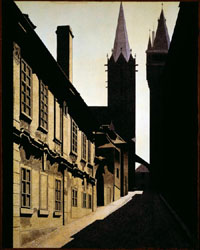
In the Renaissance, artists tended to identify themselves by reference to their place of birth (Leonardo, for example, was born in Vinci). Which is why Vojen Cech (pronounced Voyen Check), who was born in 1924 in Kolin, a town in the Czech Republic where his father was the municipal architect, signs his paintings as Colini.
That isn't the only thing Colini's paintings have in common with Renaissance art. The medium he works in is the same demanding one used during the Renaissance: Egg Tempera. Even Colini's imagery bears a certain resemblance to what you might see in a Renaissance painting. Sometimes, that's because he's painting his home town, which still resembles a medieval city. But usually it's because some essential part of Colini's soul resides in the Renaissance. He's been called a magic surrealist, but his surrealism is grounded, not in dreams, but in memory -- and whimsy.
How did an artist born 81 years ago in what was then Czechoslovakia end up in Scranton? Well, he got there by a very circuitous route. By the time the Communists took over Czechoslovakia in 1948 Colini was already in Switzerland. From there he went to -- where else? -- Paris. But he couldn't stay in France, because he didn't have papers. So he went to Venezuela and became a Venezuelan citizen. Eventually he moved to Canada and had his first show in Toronto. He left Canada for New York and divided his time between there and visits to Europe to show his paintings. Then, for a few years he and his wife, Megan, lived in Clark Summit, just outside Scranton. But two years ago they moved into a combination studio/apartment/gallery on the fourth floor of what used to be a big laundry.
Colini is the gentlest artist I have ever met. Talking about his paintings he is like a child telling you a story. Megan, by contrast, is as delightfully down-to-earth as you can get. Born in Brooklyn, she spent a good part of her life in Michigan and Texas. Debbie and I stopped by expecting to spend maybe an hour. We didn't leave until after 6 in the evening. The paintings, the couple, the stories all made the time fly by. The day felt like it was over too soon, in fact.
In the Renaissance, artists tended to identify themselves by reference to their place of birth (Leonardo, for example, was born in Vinci). Which is why Vojen Cech (pronounced Voyen Check), who was born in 1924 in Kolin, a town in the Czech Republic where his father was the municipal architect, signs his paintings as Colini.
That isn't the only thing Colini's paintings have in common with Renaissance art. The medium he works in is the same demanding one used during the Renaissance: Egg Tempera. Even Colini's imagery bears a certain resemblance to what you might see in a Renaissance painting. Sometimes, that's because he's painting his home town, which still resembles a medieval city. But usually it's because some essential part of Colini's soul resides in the Renaissance. He's been called a magic surrealist, but his surrealism is grounded, not in dreams, but in memory -- and whimsy.
How did an artist born 81 years ago in what was then Czechoslovakia end up in Scranton? Well, he got there by a very circuitous route. By the time the Communists took over Czechoslovakia in 1948 Colini was already in Switzerland. From there he went to -- where else? -- Paris. But he couldn't stay in France, because he didn't have papers. So he went to Venezuela and became a Venezuelan citizen. Eventually he moved to Canada and had his first show in Toronto. He left Canada for New York and divided his time between there and visits to Europe to show his paintings. Then, for a few years he and his wife, Megan, lived in Clark Summit, just outside Scranton. But two years ago they moved into a combination studio/apartment/gallery on the fourth floor of what used to be a big laundry.
Colini is the gentlest artist I have ever met. Talking about his paintings he is like a child telling you a story. Megan, by contrast, is as delightfully down-to-earth as you can get. Born in Brooklyn, she spent a good part of her life in Michigan and Texas. Debbie and I stopped by expecting to spend maybe an hour. We didn't leave until after 6 in the evening. The paintings, the couple, the stories all made the time fly by. The day felt like it was over too soon, in fact.
Monday, August 01, 2005
Time out for a factoid ...
In 1957, Pottsville native John O'Hara won the National Book Award for Ten North Frederick. Four years later, the National Book Award was given to Conrad Richter for The Waters of Kronos (an excellent book, by the way). Richter grew up about a 20-minute drive from Pottsville, in Pine Grove.
Sunday, July 31, 2005
Quite a discussion ...
My post of last week, A Literary visit ... has elicited quite a few comments, all of them interesting. But I found one comment in particular especially interesting. SteveD offered what he called his "two cents":
... emotions run high around Kerouac. The same's true about the nebulous grouping we call "the Beats." Regardless of who makes our Beat cut, the impact has been considerable. Yes, conspicuous lifestyles can become the focus of our attention. Kerouac expended quite a bit of energy both in his books and in his magazine articles (many of them collected in Lonesome Traveler) promoting and commodifying the Beat lifestyle as the place to be and to be free, to create better art and better social relations. His art led to and fed the art of musicians (Dylan, Jerry Garcia, Jim Morrison, etc.) and writers (Ginsberg, Burroughs, Pynchon, etc.) alike. Visions of Gerard, a particularly idiosyncratic Kerouac novel (yes, even for Kerouac), did well in my last Kerouac class. My three favorite Kerouac novels are Visions of Cody, The Subterraneans, and Desolation Angels, but most Kerouac novels appeal on some level. That is, they appeal to me. Just as "Howl," "Kaddish," and "Sunflower Sutra" do. They needn't register power or appreciation or feeling (whatever you want to call it) with everyone to have worth as literature separable from the notorious lives that produced them. Taste is taste. When I teach Kerouac, I teach the books and it isn't long before Kerouac On-the-Roaders (the kids who romanticize the lifestyle) see complexity and artful intent and execution. They also see failure and sadness. And as it should be, some students just don't dig it. I can't think of any writer's work that everyone should revere.
I especially agree that Kerouac's -- or any other books -- "needn't register power or appreciation or feeling (whatever you want to call it) with everyone to have worth as literature." I have never been able to get into George Eliot, but I would never deny that she has literary merit. Moreover, as Van Wyck Brooks once pointed out, a work of literature need not be perfect in order to have value as literature. Theodore Dreiser is a fairly clunky writer, but his works have power. Most people would agree that Faulkner is a great writer. But he can also be uneven. J.B. Priestly wrote that "within the limits of fifty pages [Faulkner] can be one of the best and one of the worst novelists in the world." Priestley cites Light in August as an example. He says it begins "wonderfully, so that we feel we are reading a masterpiece." But later on, he says, it "involve[s] us in all manner of turgid and dubious stuff, like a dream half-remembered but grandiloquently related."
But I digress. I think SteveD's students should count themselves blessed to have such a passionate teacher. I hope he can encourage them to toss in their own two cents when classes resume.
From John O'Hara to Jack Kerouac. Two American writers who wrote about the towns they grew up in. Who inspired some strong reactions in readers and neither of whom has probably be given a fair shake by critics. Also very, very different.
... emotions run high around Kerouac. The same's true about the nebulous grouping we call "the Beats." Regardless of who makes our Beat cut, the impact has been considerable. Yes, conspicuous lifestyles can become the focus of our attention. Kerouac expended quite a bit of energy both in his books and in his magazine articles (many of them collected in Lonesome Traveler) promoting and commodifying the Beat lifestyle as the place to be and to be free, to create better art and better social relations. His art led to and fed the art of musicians (Dylan, Jerry Garcia, Jim Morrison, etc.) and writers (Ginsberg, Burroughs, Pynchon, etc.) alike. Visions of Gerard, a particularly idiosyncratic Kerouac novel (yes, even for Kerouac), did well in my last Kerouac class. My three favorite Kerouac novels are Visions of Cody, The Subterraneans, and Desolation Angels, but most Kerouac novels appeal on some level. That is, they appeal to me. Just as "Howl," "Kaddish," and "Sunflower Sutra" do. They needn't register power or appreciation or feeling (whatever you want to call it) with everyone to have worth as literature separable from the notorious lives that produced them. Taste is taste. When I teach Kerouac, I teach the books and it isn't long before Kerouac On-the-Roaders (the kids who romanticize the lifestyle) see complexity and artful intent and execution. They also see failure and sadness. And as it should be, some students just don't dig it. I can't think of any writer's work that everyone should revere.
I especially agree that Kerouac's -- or any other books -- "needn't register power or appreciation or feeling (whatever you want to call it) with everyone to have worth as literature." I have never been able to get into George Eliot, but I would never deny that she has literary merit. Moreover, as Van Wyck Brooks once pointed out, a work of literature need not be perfect in order to have value as literature. Theodore Dreiser is a fairly clunky writer, but his works have power. Most people would agree that Faulkner is a great writer. But he can also be uneven. J.B. Priestly wrote that "within the limits of fifty pages [Faulkner] can be one of the best and one of the worst novelists in the world." Priestley cites Light in August as an example. He says it begins "wonderfully, so that we feel we are reading a masterpiece." But later on, he says, it "involve[s] us in all manner of turgid and dubious stuff, like a dream half-remembered but grandiloquently related."
But I digress. I think SteveD's students should count themselves blessed to have such a passionate teacher. I hope he can encourage them to toss in their own two cents when classes resume.
From John O'Hara to Jack Kerouac. Two American writers who wrote about the towns they grew up in. Who inspired some strong reactions in readers and neither of whom has probably be given a fair shake by critics. Also very, very different.
America's bard ...
A century and a half ago this month Walt Whitman self-published the first edition of Leaves of Grass. On Friday, the Wall Street Journal ran a characteristically over-the-top but altogether accurate assessment of Whitman by Harold Bloom.
Saturday, July 30, 2005



Vacation Days (Part II)
During our first visit to Lizza Studios, gallery director Betsy Green suggested that Debbie and I visit the studio of glass sculptor Christopher Ries in Keelersburg. She called ahead for us and it turned out that Ries himself would be there. It was only a fifteen-minute drive away, so we went. I know what you're thinking. "Glass sculpture -- what's that? Something like Steuben glass figures?" Well, if you've clicked on the link to his Web site you already know that what Ries does isn't remotely like that. Steuben glass figures are splendidly crafted manufactured objects. But, like all manufactured objects, they are short on individuality.
Ries's sculptures are nothing if not individual. He takes 3,000-pound blocks of crystal glass, cuts them where the flaw is (like a diamond cutter), then carves the somewhat smaller block into an abstract form, but into the form another form -- a flower, say -- will be etched, which will in turn be refracted by the light striking the sculpture and projected throughout the form. Sculpture is not usually transparent. Because of their transparency, because of the way the light, striking them, changes the pieces as the light moves, and as you move around to see the pieces from different angles, Ries's works seem to take on a further dimensionality.
Ries himself is an impressive fellow, absolutely fascinating to talk to, which Debbie and I did for a couple of hours. Many years ago I was a gallery director. I've met a lot of artists in my time. All of the best usually like to talk, not about themselves, or even about individual works, but rather about the material they work with and what goes into the process of working with it. Talking to Christopher Ries about carving glass is like talking to a mystic about God. He gives the impression of a man for whom a particular vision of -- yes, I'm going to use that word -- beauty is never for long out of his mind.
I do not mean to suggest he is some hopelessly impractical visionary. Visionary yes, but impractical -- not at all. His studio is an old barn, and has been wondrously restored -- by him. It's on a farm only yards from the Susquehanna. Ries himself grew up on a farm in Ohio, not far from the part of the state that gave the world some of its most famous pottery, including Roseville. Ries's mother wanted him to be a musician and in some way, looking at the play of light striking his sculptures, or the play of light on the wall cast by those sculptures, that is what he has become -- a composer and arranger of light. Light is an integral part of each work and he calculates the effect the light will have while he works. This is extraordinary art.
Ries's sculptures are nothing if not individual. He takes 3,000-pound blocks of crystal glass, cuts them where the flaw is (like a diamond cutter), then carves the somewhat smaller block into an abstract form, but into the form another form -- a flower, say -- will be etched, which will in turn be refracted by the light striking the sculpture and projected throughout the form. Sculpture is not usually transparent. Because of their transparency, because of the way the light, striking them, changes the pieces as the light moves, and as you move around to see the pieces from different angles, Ries's works seem to take on a further dimensionality.
Ries himself is an impressive fellow, absolutely fascinating to talk to, which Debbie and I did for a couple of hours. Many years ago I was a gallery director. I've met a lot of artists in my time. All of the best usually like to talk, not about themselves, or even about individual works, but rather about the material they work with and what goes into the process of working with it. Talking to Christopher Ries about carving glass is like talking to a mystic about God. He gives the impression of a man for whom a particular vision of -- yes, I'm going to use that word -- beauty is never for long out of his mind.
I do not mean to suggest he is some hopelessly impractical visionary. Visionary yes, but impractical -- not at all. His studio is an old barn, and has been wondrously restored -- by him. It's on a farm only yards from the Susquehanna. Ries himself grew up on a farm in Ohio, not far from the part of the state that gave the world some of its most famous pottery, including Roseville. Ries's mother wanted him to be a musician and in some way, looking at the play of light striking his sculptures, or the play of light on the wall cast by those sculptures, that is what he has become -- a composer and arranger of light. Light is an integral part of each work and he calculates the effect the light will have while he works. This is extraordinary art.
Friday, July 29, 2005
An important anniversary ...
On this date in 1905 in Jönköping, Swed., Dag Hammarskjöld was born. He was a great man, and certainly the greatest to hold the position of United Nations Secretary-General. He also wrote a book, Markings, which was the first I ever reviewed professionally. Markings, which Hammarskjöld described as "a sort of White Book concerning my negotiations with myself - and with God," was in the news earlier this year, when questions were again raised as to the accuracy of the translation, done by poet W.H. Auden in collaboboration with Leif Sjöberg. I had some questions myself at the time, but not about the Swedish, which I remain incompetent to comment upon. I thought the translation of one part of Hölderlin's "Hälfte des Lebens" was peculiar (I haven't the text in front of me, so I can't be more specific). Nevertheless, I think that Markings should perhaps be read with caution, but it should be read. And maybe somebody should do a new translation.
Thursday, July 28, 2005


Vacation Days (Part I)
For me much of the pleasure derived from a vacation is negative: not having to answer email, or take or return phone calls, or open, sort and shelve books. Still, I don't leave my job behind entirely, for the simple reason that I like what I do. Who wouldn't? I read books. I get to sound off about them. And I get paid for it.
On this last vacation I managed to read about six books, write four reviews, a couple of poems, and some miscellaneous things.
But it was far from being a busman's holiday. My wife, Debbie, paints and sculpts, and when she noticed there was a gallery in Tunkhannock she wanted to go. And go we did to Lizza Fine Art Studios, which proved to be a very nice exhibition space with beautiful hardwood floors (it used to be a roller skating rink). But it had more than just paintings on the walls (by Nancy Ruch Kim, a graduate of Moore College of Art & Design and the Pennsylvania Academy of Fine Arts) and sculptures and ceramics on pedestals (the former by Douglas Leidy, the latter by Mark Chuck).
We got to talking with owner Bob Lizza and gallery director Betsy Green and learned that, thanks to Lizza Studios, little Tunkhannock, Pa., has won itself a place in the sun in the world of art. Seems that New York's mighty Metropolitan Museum of Art had a tapestry and a painting scanned there.
Also scanned there was a painting titled "La Madonna Della Luce" ("Our Lady of Light") painted by the Vatican artist of the year, Natalia Tsarkova. (The painting was commissioned by the Primavera Fine Art Foundation for Pope John Paul II and the foundation says it has been informed that it was one of the last works of art blessed by the Pontiff before his death. The painting -- which represents the Mysteries of Light the Pope added to the rosary -- will eventually hang in the Vatican, but right now it's on tour.
Why was the scanning done in Tunkhannock? Turns out Lizza Studios has one of the few Cruse CS 285 ST Scanners in the world. Which means they can make the best giclee prints imaginable. Just how good these prints are was brought home to Debbie and me when we were looking at a matted collage by Marvin Baker in the back of the studio. Betsy remarked that it was one of their showpieces and Bob suggested to Debbie that she reach over and pluck off one of the slips of paper the collage was made of. She asked him if he was sure he wanted her to do that and he assured her it was OK. Of course, when she reached over to do it, she found there was nothing to pluck: It just looked vividly two-dimensional.
And this first visit to the Lizza Studios was only the beginning of our artistic adventures in Tunkhannock.
On this last vacation I managed to read about six books, write four reviews, a couple of poems, and some miscellaneous things.
But it was far from being a busman's holiday. My wife, Debbie, paints and sculpts, and when she noticed there was a gallery in Tunkhannock she wanted to go. And go we did to Lizza Fine Art Studios, which proved to be a very nice exhibition space with beautiful hardwood floors (it used to be a roller skating rink). But it had more than just paintings on the walls (by Nancy Ruch Kim, a graduate of Moore College of Art & Design and the Pennsylvania Academy of Fine Arts) and sculptures and ceramics on pedestals (the former by Douglas Leidy, the latter by Mark Chuck).
We got to talking with owner Bob Lizza and gallery director Betsy Green and learned that, thanks to Lizza Studios, little Tunkhannock, Pa., has won itself a place in the sun in the world of art. Seems that New York's mighty Metropolitan Museum of Art had a tapestry and a painting scanned there.
Also scanned there was a painting titled "La Madonna Della Luce" ("Our Lady of Light") painted by the Vatican artist of the year, Natalia Tsarkova. (The painting was commissioned by the Primavera Fine Art Foundation for Pope John Paul II and the foundation says it has been informed that it was one of the last works of art blessed by the Pontiff before his death. The painting -- which represents the Mysteries of Light the Pope added to the rosary -- will eventually hang in the Vatican, but right now it's on tour.
Why was the scanning done in Tunkhannock? Turns out Lizza Studios has one of the few Cruse CS 285 ST Scanners in the world. Which means they can make the best giclee prints imaginable. Just how good these prints are was brought home to Debbie and me when we were looking at a matted collage by Marvin Baker in the back of the studio. Betsy remarked that it was one of their showpieces and Bob suggested to Debbie that she reach over and pluck off one of the slips of paper the collage was made of. She asked him if he was sure he wanted her to do that and he assured her it was OK. Of course, when she reached over to do it, she found there was nothing to pluck: It just looked vividly two-dimensional.
And this first visit to the Lizza Studios was only the beginning of our artistic adventures in Tunkhannock.
An interesting date ...
Today's a date filled with literary anniversaries. Poet Gerard Manley Hopkins was born on this date in 1844. Twenty-two years later, on the same date, Beatrix Potter, the creator of Peter Rabbit, was born. And finally, in 1907 on July 28, Malcolm Lowry, author of Under the Volcano was born.
In 1655, Cyrano de Bergerac died in Paris.
In 1655, Cyrano de Bergerac died in Paris.
Wednesday, July 27, 2005
Roger Simon links to a fine piece on Ibsen by Theodore Dalrymple. A key passage:
However, most people find it more comforting to believe in perfectibility than in imperfectibility—an example of what Dr. Johnson called the triumph of hope over experience. The notion of imperfectibility not only fans existential anxieties, but also—by precluding simple solutions to all human problems—places much tougher intellectual demands upon us than utopianism does. Not every question can be answered by reference to a few simple abstract principles that, if followed with sufficient rigor, will supposedly lead to perfection—which is why conservatism is so much more difficult to reduce to slogans than its much more abstract competitors.
This is worth bearing mind when reading this dialogue in Foreign Policy between Carl Pope, executive director of the Sierra Club, and Bjorn Lonborg, author of The Skeptical Environmentalist.
Dalrymple is, I believe, right about the Ibsen plays he discusses. But I think Ibsen's work as a whole ought to be judged by his later plays, especially The Master Builder and John Gabriel Borkman. In these, the egoism at the center of the others is itself weighed in the balance and found wanting.
However, most people find it more comforting to believe in perfectibility than in imperfectibility—an example of what Dr. Johnson called the triumph of hope over experience. The notion of imperfectibility not only fans existential anxieties, but also—by precluding simple solutions to all human problems—places much tougher intellectual demands upon us than utopianism does. Not every question can be answered by reference to a few simple abstract principles that, if followed with sufficient rigor, will supposedly lead to perfection—which is why conservatism is so much more difficult to reduce to slogans than its much more abstract competitors.
This is worth bearing mind when reading this dialogue in Foreign Policy between Carl Pope, executive director of the Sierra Club, and Bjorn Lonborg, author of The Skeptical Environmentalist.
Dalrymple is, I believe, right about the Ibsen plays he discusses. But I think Ibsen's work as a whole ought to be judged by his later plays, especially The Master Builder and John Gabriel Borkman. In these, the egoism at the center of the others is itself weighed in the balance and found wanting.
Tuesday, July 26, 2005
A literary visit ...
Pottsville was only a little out of the way en route to the house in Vosburg — about five miles west of Tunkhannock — where my wife and I spent the last couple of weeks. So we stopped and spent a night in Pottsville, where novelist John O'Hara was born a century ago. While there I read “The Girl on the Baggage Truck,” the first of the three novellas that comprise Sermons and Soda-Water, one of his best books, published in 1960, a decade before his death.
O’Hara was pretty much persona non grata in Pottsville while he was alive, but now there are markers around and about the town indicating sites that served as the originals for those in O’Hara’s “Gibbsville.” The model for the John Gibb Hotel is right at the corner of Centre Street and Mahantongo (which O’Hara renamed Latenengo). Next door is the office of the Pottsville Republican, O’Hara’s Gibbsville Standard. Across the street is the Reading Iron and Coal Co., a few doors away is the building O’Hara was born in, and where his physician father’s office remained after the family moved up the street (on the other side, across from the mansions). Not too far up, right next to the Yuengling brewery, is St. Patrick’s Church, which O’Hara reconsecrated as SS. Peter and Paul.
These places are a matter of yards apart. It seems an extremely small space to have a fictional world from. But maybe not. I suppose we’ve all had the experience of revisiting a place we knew only as small children and being surprised at how small it is compared to how large it loomed in our memory. But we were small when we experienced and that is what we remember. A person sensitive enough while still young might later on easily construct in imagination an entire world out of so large a piece of memory.
O’Hara was pretty much persona non grata in Pottsville while he was alive, but now there are markers around and about the town indicating sites that served as the originals for those in O’Hara’s “Gibbsville.” The model for the John Gibb Hotel is right at the corner of Centre Street and Mahantongo (which O’Hara renamed Latenengo). Next door is the office of the Pottsville Republican, O’Hara’s Gibbsville Standard. Across the street is the Reading Iron and Coal Co., a few doors away is the building O’Hara was born in, and where his physician father’s office remained after the family moved up the street (on the other side, across from the mansions). Not too far up, right next to the Yuengling brewery, is St. Patrick’s Church, which O’Hara reconsecrated as SS. Peter and Paul.
These places are a matter of yards apart. It seems an extremely small space to have a fictional world from. But maybe not. I suppose we’ve all had the experience of revisiting a place we knew only as small children and being surprised at how small it is compared to how large it loomed in our memory. But we were small when we experienced and that is what we remember. A person sensitive enough while still young might later on easily construct in imagination an entire world out of so large a piece of memory.

Thursday, July 14, 2005
Taking a break
A hearty thanks to Katie for filling in for Frank for the past few days. Starting today, Books, Inq. is going on hiatus until Frank gets back in late July.
Monday, July 11, 2005
Read "The Great Switcheroo" and you'll see what I mean
Margaret Talbot has a nice essay about Roald Dahl in this week's New Yorker. She writes that while kids devour his stuff, it puts many adults off—the children's books, anyway. "Dahl’s books regularly show up on the American Library Association’s list of titles that patrons ask to be restricted from young children or removed from the shelves," she writes. Indeed, his stories were often lurid, violent, and eccentric. But that's exactly why kids like them, Talbot says. Virtuous children fight—and win—the good fight, and rotten grownups always get theirs in the end.
Most of Dahl's early stories were for adults, Talbot writes, and while The New Yorker accepted a few early in his career their popularity soon waned. "Dahl's adult stories were crisply, shiveringly enjoyable—rather like "Twilight Zone" episodes—but they showed little compassion or psychological penetration. It was children, it seemed, not adults, on whom Dahl could lavish empathy."
True, they don't brim with benevolence. In one, "Lamb to the Slaughter," a lady gives her disagreeable husband the quietus with a frozen leg of lamb, then cooks and serves it to the cops who come to investigate the murder. But again, that nastiness is Dahl's charm. He could be viciously funny or deliciously droll, and his perceptions were dead-on. I've always remembered this description from "The Way Up to Heaven": "The chauffeur, a man with a small rebellious Irish mouth, didn't care very much for any of this..." And the stories in Switch Bitch, incidentally, are downright scandalous. The two books that make up his memoirs, Boy and Going Solo, bridge the kid-adult gap nicely. No questionable content, lots of exciting accounts from his days as a Royal Air Force fighter pilot, and the underlying sweetness of his worldview—his pro-underdog sentiments, his intense love of family—shines through on every page.
Thoughts?
--Katie
Most of Dahl's early stories were for adults, Talbot writes, and while The New Yorker accepted a few early in his career their popularity soon waned. "Dahl's adult stories were crisply, shiveringly enjoyable—rather like "Twilight Zone" episodes—but they showed little compassion or psychological penetration. It was children, it seemed, not adults, on whom Dahl could lavish empathy."
True, they don't brim with benevolence. In one, "Lamb to the Slaughter," a lady gives her disagreeable husband the quietus with a frozen leg of lamb, then cooks and serves it to the cops who come to investigate the murder. But again, that nastiness is Dahl's charm. He could be viciously funny or deliciously droll, and his perceptions were dead-on. I've always remembered this description from "The Way Up to Heaven": "The chauffeur, a man with a small rebellious Irish mouth, didn't care very much for any of this..." And the stories in Switch Bitch, incidentally, are downright scandalous. The two books that make up his memoirs, Boy and Going Solo, bridge the kid-adult gap nicely. No questionable content, lots of exciting accounts from his days as a Royal Air Force fighter pilot, and the underlying sweetness of his worldview—his pro-underdog sentiments, his intense love of family—shines through on every page.
Thoughts?
--Katie
Saturday, July 09, 2005
Zines, found poetry, and other literature for the people, by the people
Hello everyone!
I'm Katie, and I'm delighted to be taking over the Inquirer's books blog for a couple of weeks. Frank was kind enough to mention that I do a print zine on language called The La-La Theory, so I think I'll take the opportunity to tell you about the third annual Philadelphia Zine Fest, which is taking place next weekend.
Last year's fest was a success, and an absolute blast. Zinesters and other artists came from all over the country to pack themselves into the stuffy Rotunda (remember how hot it was last summer?) and share their work. Zines are handmade, one-of-a-kind, self-published journals on every subject imaginable, often traded for other zines or sold for not much more than $1 a copy. I still have copies of Christoph Meyer's lovely, spooky little story, "The Heart Star," with its linoleum block print cover; "The Glovebox Chronicles," a multiple-collaborator collection of road trip stories; "Suburban Gothic" Issue 3.5, a tiny photocopied account of depression; and "The Joy of Tuna," a totally insane photo/word/recipe collage devoted to the wonderment that is canned tuna fish. The zine movement is often considered an early-90s phenomenon, and indeed, that's when it was in the public eye for a hot 15 minutes. But clearly, here in the 21st century, the lively, delightful spirit of the DIY revolution is alive and well.
The La-La Theory takes its name from the oddball term Danish linguist Otto Jespersen (1860-1943) gave to one of the theories of the origin of language: that it was borne of the human need to express love and poetry. Unlikely, theory-wise, but awfully nice. One issue is called "Mrkgnao!", and it's about the ways different languages express animal sounds. (That weird word is the sound Mr. Bloom's cat makes in Ulysses.) I'll also bring a few copies of Word Math, a collection of found poetry I made for last year's fest. Found poetry is exciting because it takes the DIY idea to an even higher level. Essentially, the idea is to make (well, find, really) poetry from any non-poetic context: street signs, rearranged sentences from a physics textbook, you name it. Here's what poet Tom Hansen said about the creation of found poetry:
"Most found poems begin their lives as passages of expository prose. Their intended purpose is to feed easily digestible information to the reader. Nothing could be less poetic. But suddenly poetry is discovered embedded within the prose. The discoverer is someone alert to the possibilities of irony, absurdity, and other incongruities." ("Letting Language Do: Some Speculations on Finding Found Poems," College English 42, 1979)
In other words, the discoverer—the poet—can be anyone. Like me. And you.
Till soon,
Katie
I'm Katie, and I'm delighted to be taking over the Inquirer's books blog for a couple of weeks. Frank was kind enough to mention that I do a print zine on language called The La-La Theory, so I think I'll take the opportunity to tell you about the third annual Philadelphia Zine Fest, which is taking place next weekend.
Last year's fest was a success, and an absolute blast. Zinesters and other artists came from all over the country to pack themselves into the stuffy Rotunda (remember how hot it was last summer?) and share their work. Zines are handmade, one-of-a-kind, self-published journals on every subject imaginable, often traded for other zines or sold for not much more than $1 a copy. I still have copies of Christoph Meyer's lovely, spooky little story, "The Heart Star," with its linoleum block print cover; "The Glovebox Chronicles," a multiple-collaborator collection of road trip stories; "Suburban Gothic" Issue 3.5, a tiny photocopied account of depression; and "The Joy of Tuna," a totally insane photo/word/recipe collage devoted to the wonderment that is canned tuna fish. The zine movement is often considered an early-90s phenomenon, and indeed, that's when it was in the public eye for a hot 15 minutes. But clearly, here in the 21st century, the lively, delightful spirit of the DIY revolution is alive and well.
The La-La Theory takes its name from the oddball term Danish linguist Otto Jespersen (1860-1943) gave to one of the theories of the origin of language: that it was borne of the human need to express love and poetry. Unlikely, theory-wise, but awfully nice. One issue is called "Mrkgnao!", and it's about the ways different languages express animal sounds. (That weird word is the sound Mr. Bloom's cat makes in Ulysses.) I'll also bring a few copies of Word Math, a collection of found poetry I made for last year's fest. Found poetry is exciting because it takes the DIY idea to an even higher level. Essentially, the idea is to make (well, find, really) poetry from any non-poetic context: street signs, rearranged sentences from a physics textbook, you name it. Here's what poet Tom Hansen said about the creation of found poetry:
"Most found poems begin their lives as passages of expository prose. Their intended purpose is to feed easily digestible information to the reader. Nothing could be less poetic. But suddenly poetry is discovered embedded within the prose. The discoverer is someone alert to the possibilities of irony, absurdity, and other incongruities." ("Letting Language Do: Some Speculations on Finding Found Poems," College English 42, 1979)
In other words, the discoverer—the poet—can be anyone. Like me. And you.
Till soon,
Katie
Friday, July 08, 2005
Hail and farewell ...
Tomorrow, my wife and I will be taking off for two weeks in a cabin (a very nicely appointed cabin) near Tunkhannock, Wyoming County. We return July 25. So no more blogging for me for awhile. In my absence, the blogging duties will be assumed by Katie Haegele, who reviews young adult novels (and much else besides) for The Inquirer. She's also responsible for a zine about language called The La-La Theory (Katie studied linguistics at Penn). So welcome Katie!
On second thought ...
I realize that, in the luncheon talk I gave at the Franklin Inn Club recently, I overstated my case at one point and I want to clear things up before I take off on vacation. I said it was silly for people talk about reading the Bible literally. "No text, least of all one as rich as the Bible, deserves to be read that way, because it reduces words to mere signs." Allow me to rephrase that: No text as rich as the Bible deserves to be read that way.
But not all texts are rich and not all texts are meant to be. This occurred to me as I thought over some remarks that were made after my talk by Gresham Riley, the former president of the Pennsylvania Academy of the Fine Arts. Gresham thought that what I had to say had some bearing on the debate over constitutional interpretation -- the "original intent" people versus the "living document" crowd. At first I was inclined to agree somewhat, but then I thought to myself that one thing I didn't want to suggest was that we can read a text any way we like.
There are necessary limits on our intrepretive freedom. One should, for instance, make sure that one undertsand the words in the sense that the author understood them. Words do accrue meanings over the years and a later sense will not apply to a text written before that sense developed.
Also, there are texts that we want to be unambiguously clear: for instance, the instructions for assembling the toy you bought one of your kids for Christmas.
I do not think the Constitution is a rich text, nor do I think it was meant to be. The problems that arise over interpreting it tend to derive from one or another party wanting it to address what it in fact does not. There is nothing in the Constitution about abortion because no one in 1789 would have thought to put it there.
I think that what we need to do with regard to the text of the Constitution is not align ourselves with any school of interpretation, but rather devote some more of our time to simply reading it for ourselves. After all, before you can determine what a document means, you must first determine as accurately as you can what it says. If more people were better acquainted with the text of the Constitution fewer people would be able to get away with bloviating on it.
But not all texts are rich and not all texts are meant to be. This occurred to me as I thought over some remarks that were made after my talk by Gresham Riley, the former president of the Pennsylvania Academy of the Fine Arts. Gresham thought that what I had to say had some bearing on the debate over constitutional interpretation -- the "original intent" people versus the "living document" crowd. At first I was inclined to agree somewhat, but then I thought to myself that one thing I didn't want to suggest was that we can read a text any way we like.
There are necessary limits on our intrepretive freedom. One should, for instance, make sure that one undertsand the words in the sense that the author understood them. Words do accrue meanings over the years and a later sense will not apply to a text written before that sense developed.
Also, there are texts that we want to be unambiguously clear: for instance, the instructions for assembling the toy you bought one of your kids for Christmas.
I do not think the Constitution is a rich text, nor do I think it was meant to be. The problems that arise over interpreting it tend to derive from one or another party wanting it to address what it in fact does not. There is nothing in the Constitution about abortion because no one in 1789 would have thought to put it there.
I think that what we need to do with regard to the text of the Constitution is not align ourselves with any school of interpretation, but rather devote some more of our time to simply reading it for ourselves. After all, before you can determine what a document means, you must first determine as accurately as you can what it says. If more people were better acquainted with the text of the Constitution fewer people would be able to get away with bloviating on it.
Evan Hunter (1926-2005)
Evan Hunter, author of Blackboard Jungle, was perhaps better known as Ed McBain, author of the 87th Precinct novels, the prototype of the police procedural subgenre of crime fiction. Hunter/McBain -- who was born Salvatore Lombino -- died Wednesday. Here is an obit in the Times of London and another in the Daily Telegraph.
In a way, Hunter made a major contribution to the creation of modern youth culture: Richard Brooks' 1955 film version of Blackboard Jungle, starring Glenn Ford and Sidney Poitier, was the first film to feature rock music on the sound track -- Bill Haley and the Comets doing "Rock Around the Clock."
In a way, Hunter made a major contribution to the creation of modern youth culture: Richard Brooks' 1955 film version of Blackboard Jungle, starring Glenn Ford and Sidney Poitier, was the first film to feature rock music on the sound track -- Bill Haley and the Comets doing "Rock Around the Clock."
Monday, July 04, 2005
Christopher Fry (1907-2005)
One of Margaret Thatcher's most famous lines occurred in response to speculation as to whether she would make an about-turn on her anti-inflationary policies. "To those waiting with bated breath for that favourite media catchphrase, the U-turn," she said, "I have only one thing to say: You turn if you want to. The lady's not for turning!"
She was alluding, of course, to Christopher Fry's play The Lady's Not for Burning, quite a hit in its day, as was Fry himself. The self-centered grousing of John Osborne's Jimmy Porter and the like drove lyrical optimists like Fry out of the theater.
Fry died on Thursday last. Here is an obituary in the Daily Telgraph and another in the Times of London.
She was alluding, of course, to Christopher Fry's play The Lady's Not for Burning, quite a hit in its day, as was Fry himself. The self-centered grousing of John Osborne's Jimmy Porter and the like drove lyrical optimists like Fry out of the theater.
Fry died on Thursday last. Here is an obituary in the Daily Telgraph and another in the Times of London.
Sunday, July 03, 2005
Steppenwolf and the Pope ...
Back in May, Chris Bauer had some interesting things to say about Pope Benedict XVI and Hermann Hesse's novel Steppenwolf and ... Lance Armstrong, as well as a few other things. Definitely worth a look.
Saturday, July 02, 2005
A literary birthday ...
I first encountered Hermann Hesse in German class. I don't recall now if it was in high school or college. But the story was called "Der Wolf."
I know I was a sophomore in college when I came upon Steppenwolf. It was an odd Friday noght when I had nothing better to do and I stayed up reading until I finished the book.
I was immensely affected by it (it is also a favorite book of the new Pope).
The version I read was a newly-released Modern Library edition and, except for the New Directions edition of Siddartha, was the only book of Hesse's available in this country at the time (this was at the beginning of 1962). But there was a little bookstore on 15th Street, near Market, that started to stock editions of Hesse's novels published in Britain. Which is how I got to read all of them long before Hesse became a cult author. I haven't read them since and suspect I would not enjoy them as much as I did then. Anymore than I would enjoy being again who I was then.
Hermann Hesse was born on this date in 1877 in Calw, Germany.
I know I was a sophomore in college when I came upon Steppenwolf. It was an odd Friday noght when I had nothing better to do and I stayed up reading until I finished the book.
I was immensely affected by it (it is also a favorite book of the new Pope).
The version I read was a newly-released Modern Library edition and, except for the New Directions edition of Siddartha, was the only book of Hesse's available in this country at the time (this was at the beginning of 1962). But there was a little bookstore on 15th Street, near Market, that started to stock editions of Hesse's novels published in Britain. Which is how I got to read all of them long before Hesse became a cult author. I haven't read them since and suspect I would not enjoy them as much as I did then. Anymore than I would enjoy being again who I was then.
Hermann Hesse was born on this date in 1877 in Calw, Germany.
Thursday, June 30, 2005
A luncheon talk ...
I was invited to speak this afternoon over lunch at the Franklin Inn Club. What follows is a version of my remarks:
My topic is Reading as a Creative Act.
What’s that supposed to mean? Writing — that’s creative, at least it can be. But reading? What’s creative about that?
Well, let me remind you of an experience I suspect everyone in this room has had at one time or another:
You go the movies and see a picture based on a novel that you’ve read and enjoyed. And you find you’re disappointed — because you imagined it all differently from the way the filmmakers did. You imagined it in your own particular way, a highly personal way.
So consider: An imaginative writer — a novelist, say — creates a text. But that text remains in what the medieval scholastics called a state of potency until somebody reads it. Reading actuates the potency. But the reader does that by bringing to bear on the text his or her own imagination.
It’s a lot like what happens when an instrumentalist plays a piece of music. If you heard me play the Prelude No. 1 from Bach’s first book of the Well-Tempered Clavier and then put on a recording of Sviatoslav Richter playing the same piece, you’d know right away who was the more creative reader of the score.
Moreover, when you play a piece of music and everything goes right, even though it’s your fingers striking the keys, and your foot on the pedal, the experience you have sitting there isn’t so much of something that you’re doing as it is of something that is happening through you. “You are the music while the music lasts,” as Eliot put it. No good musician ever plays exactly what’s written down. He brings to what he is playing a wealth of knowledge, skill, taste, and experience.
The same thing happens often when you’re reading. You get completely absorbed. You lose all sense of time and place and even, sometimes, the sense of yourself. You’re with Nostromo in Panama or soaring over the rooftops of London with Scrooge and one of the Christmas ghosts. You’re no longer here and now. Now, you’re there.
That’s why it’s so silly when people talk about reading the Bible literally. No text, least of all one as rich as the Bible, deserves to be read that way, because it reduces words to mere signs. And words are more than signs. They’re symbols. They have connotations. They resonate. They’re redolent.
This is something I’ve come to think about a lot since becoming The Inquirer’s book review editor five years ago. I’ve been reviewing books professionally for over 40 years, and I’ve been an avid reader since childhood. But when I got this job I found myself reading more than I ever had before.
And I discovered something very intriguing. I found my interest in more passive forms of entertainment had dropped noticeably. I can hardly watch television at all. Most of the shows seem hardly to rub elbows with reality. I also find myself impatient at movies. As often as not they don’t engage me as quickly and completely as a good book can. They leave too little up to my imagination.
This has led me to a better understanding of what I think my job ought to be about. I have found that a lot of people in my position think that they are somehow or other in the service of LIT-rature. I see myself as being in the service of reading — and readers. Because I think it is very important that people realize how essential the act of reading is to maintaining a mind that is active.
Of course, there is reading and there is reading. Readers can fall into a rut, reading the same sort of thing over and over. That’s fine if what you’re reading and re-reading is something like Dante’s Divina Commedia or Shakespeare’s plays. Those texts are practically infinite in their richness. Now I like thrillers; I read and review a lot of them — but a steady diet of them lulls the mind into a pattern of repetition. And repetition weakens the mind.
That’s why it’s important to maintain one’s acquaintance with the classics. And with poetry, the richest, most concentrated form of verbal expression. Engagement with a truly rich text enables the mind to encounter the world afresh. And we feel more alive when the world looks fresh.
So I will conclude with a poem, one by Wallace Stevens, which makes some of the same points I have been trying to — but in a far more elegant way than I ever could. It’s called “The house was quiet and the world was calm.”
The house was quiet and the world was calm.
The reader became the book; and summer night
Was like the conscious being of the book.
The house was quiet and the world was calm.
The words were spoken as if there was no book,
Except that the reader leaned above the page,
Wanted to lean, wanted much to be
The scholar to whom his book is true, to whom
The summer night is like a perfection of thought.
The house was quiet because it had to be.
The quiet was part of the meaning, part of the mind:
The access of perfection to the page.
And the world was calm. The truth in a calm world,
In which there is no other meaning, itself
Is calm, itself is summer and night, itself
Is the reader leaning late and reading there.
My topic is Reading as a Creative Act.
What’s that supposed to mean? Writing — that’s creative, at least it can be. But reading? What’s creative about that?
Well, let me remind you of an experience I suspect everyone in this room has had at one time or another:
You go the movies and see a picture based on a novel that you’ve read and enjoyed. And you find you’re disappointed — because you imagined it all differently from the way the filmmakers did. You imagined it in your own particular way, a highly personal way.
So consider: An imaginative writer — a novelist, say — creates a text. But that text remains in what the medieval scholastics called a state of potency until somebody reads it. Reading actuates the potency. But the reader does that by bringing to bear on the text his or her own imagination.
It’s a lot like what happens when an instrumentalist plays a piece of music. If you heard me play the Prelude No. 1 from Bach’s first book of the Well-Tempered Clavier and then put on a recording of Sviatoslav Richter playing the same piece, you’d know right away who was the more creative reader of the score.
Moreover, when you play a piece of music and everything goes right, even though it’s your fingers striking the keys, and your foot on the pedal, the experience you have sitting there isn’t so much of something that you’re doing as it is of something that is happening through you. “You are the music while the music lasts,” as Eliot put it. No good musician ever plays exactly what’s written down. He brings to what he is playing a wealth of knowledge, skill, taste, and experience.
The same thing happens often when you’re reading. You get completely absorbed. You lose all sense of time and place and even, sometimes, the sense of yourself. You’re with Nostromo in Panama or soaring over the rooftops of London with Scrooge and one of the Christmas ghosts. You’re no longer here and now. Now, you’re there.
That’s why it’s so silly when people talk about reading the Bible literally. No text, least of all one as rich as the Bible, deserves to be read that way, because it reduces words to mere signs. And words are more than signs. They’re symbols. They have connotations. They resonate. They’re redolent.
This is something I’ve come to think about a lot since becoming The Inquirer’s book review editor five years ago. I’ve been reviewing books professionally for over 40 years, and I’ve been an avid reader since childhood. But when I got this job I found myself reading more than I ever had before.
And I discovered something very intriguing. I found my interest in more passive forms of entertainment had dropped noticeably. I can hardly watch television at all. Most of the shows seem hardly to rub elbows with reality. I also find myself impatient at movies. As often as not they don’t engage me as quickly and completely as a good book can. They leave too little up to my imagination.
This has led me to a better understanding of what I think my job ought to be about. I have found that a lot of people in my position think that they are somehow or other in the service of LIT-rature. I see myself as being in the service of reading — and readers. Because I think it is very important that people realize how essential the act of reading is to maintaining a mind that is active.
Of course, there is reading and there is reading. Readers can fall into a rut, reading the same sort of thing over and over. That’s fine if what you’re reading and re-reading is something like Dante’s Divina Commedia or Shakespeare’s plays. Those texts are practically infinite in their richness. Now I like thrillers; I read and review a lot of them — but a steady diet of them lulls the mind into a pattern of repetition. And repetition weakens the mind.
That’s why it’s important to maintain one’s acquaintance with the classics. And with poetry, the richest, most concentrated form of verbal expression. Engagement with a truly rich text enables the mind to encounter the world afresh. And we feel more alive when the world looks fresh.
So I will conclude with a poem, one by Wallace Stevens, which makes some of the same points I have been trying to — but in a far more elegant way than I ever could. It’s called “The house was quiet and the world was calm.”
The house was quiet and the world was calm.
The reader became the book; and summer night
Was like the conscious being of the book.
The house was quiet and the world was calm.
The words were spoken as if there was no book,
Except that the reader leaned above the page,
Wanted to lean, wanted much to be
The scholar to whom his book is true, to whom
The summer night is like a perfection of thought.
The house was quiet because it had to be.
The quiet was part of the meaning, part of the mind:
The access of perfection to the page.
And the world was calm. The truth in a calm world,
In which there is no other meaning, itself
Is calm, itself is summer and night, itself
Is the reader leaning late and reading there.
Tuesday, June 28, 2005
Tales of two novelists ...
On Friday Ann Althouse linked to Richard Lawrence Cohen's example of a Literary Rivalry. Part Two of Rivalry appeared on Sunday.
I think the first of these defines two equally valid approaches. Joseph Conrad and Graham Greene traveled the world. Jane Austen and William Faulkner pretty much stayed at home.
The second difference I'm not so sure about. I think most writers work at their craft every day, and make their own inspiration.
I think the first of these defines two equally valid approaches. Joseph Conrad and Graham Greene traveled the world. Jane Austen and William Faulkner pretty much stayed at home.
The second difference I'm not so sure about. I think most writers work at their craft every day, and make their own inspiration.
Monday, June 27, 2005
Blogging hiatus ...
I was so busy last week I didn't realize how large the blogging gap had become. But we were short-handed at the office (which happens this time of the year), so we all pitched in to get things done.
But this gives me an opportunity to let people behind the scenes, which is one of the things this blog is about.
I went to BookExpo America at the beginning of June. That meant being out of the office for a couple of days. And that meant that email, books, and regular mail would pile up. So what? you ask. It's only a couple of days. A couple of days in my job can mean a couple of hundred books and at least a couple of hundred emails. I have nearly 2,000 in my inbox right now, which I must dutifully plow through before I start my vacation on July 8.
But that's not all. After I got back from BEA, I had to prepare for a panel I was on at the Rosenbach Museum as part of its annual Bloomsday celebration. And I was a featured reader at Bloomsday as well. All such things require preparation -- unless you're content to make a fool of yourself in public, which I admit I'm reluctant to do. This week I'm trying to move reviews for the rest of July -- and I'm scheduled to give a talk at the Franklin Inn cLub on Thursday.
All of which means I will barely keep my head above the waters of the clerical flood.
Still, I plan to resume regular blogging tomorrow morning.
But this gives me an opportunity to let people behind the scenes, which is one of the things this blog is about.
I went to BookExpo America at the beginning of June. That meant being out of the office for a couple of days. And that meant that email, books, and regular mail would pile up. So what? you ask. It's only a couple of days. A couple of days in my job can mean a couple of hundred books and at least a couple of hundred emails. I have nearly 2,000 in my inbox right now, which I must dutifully plow through before I start my vacation on July 8.
But that's not all. After I got back from BEA, I had to prepare for a panel I was on at the Rosenbach Museum as part of its annual Bloomsday celebration. And I was a featured reader at Bloomsday as well. All such things require preparation -- unless you're content to make a fool of yourself in public, which I admit I'm reluctant to do. This week I'm trying to move reviews for the rest of July -- and I'm scheduled to give a talk at the Franklin Inn cLub on Thursday.
All of which means I will barely keep my head above the waters of the clerical flood.
Still, I plan to resume regular blogging tomorrow morning.
Monday, June 20, 2005
A Joycean coincidence ...
Last year, Inquirer photographer Eric Mencher and I went to Dublin to follow in the footsteps of Leopold Bloom in order to do a piece for the Bloomsday Centenary.
Last week, Eric was at the Consitution Center taking photos for the paper and met an Italian journalist, Anna Casanova, who was here to write a travel piece about our fair city. Eric suggested she visit the Rosenbach Museum & Library, which was just about to celebrate Bloomsday once again, as it does every year (the manuscript of Ulysses resides there). Ms. Casanova told him she had already been there, that it was the reason she was in the city. Seems she had seen the work Eric and I did online (which really means she was taken by his spectacular photos) and used it to pitch a story about Philly.
Sounds like something Joyce would have made up.
Last week, Eric was at the Consitution Center taking photos for the paper and met an Italian journalist, Anna Casanova, who was here to write a travel piece about our fair city. Eric suggested she visit the Rosenbach Museum & Library, which was just about to celebrate Bloomsday once again, as it does every year (the manuscript of Ulysses resides there). Ms. Casanova told him she had already been there, that it was the reason she was in the city. Seems she had seen the work Eric and I did online (which really means she was taken by his spectacular photos) and used it to pitch a story about Philly.
Sounds like something Joyce would have made up.

Sunday, June 19, 2005
Orwell to the rescue ...
For those inclined to give Illinois Sen. Dick Durbin a pass on his remarks this past week comparing alleged bad behavior at Gitmo to the Holocaust, the Gulag, and the Cambodian Killing Fields, I link to George Orwell's Politics and the English Language.
Consider this: "A man may take to drink because he feels himself to be a failure, and then fail all the more completely because he drinks. It is rather the same thing that is happening to the English language. It becomes ugly and inaccurate because our thoughts are foolish, but the slovenliness of our language makes it easier for us to have foolish thoughts."
And this: "When one watches some tired hack on the platform mechanically repeating the familiar phrases -- bestial, atrocities, iron heel, bloodstained tyranny, free peoples of the world, stand shoulder to shoulder -- one often has a curious feeling that one is not watching a live human being but some kind of dummy ... And this is not altogether fanciful. A speaker who uses that kind of phraseology has gone some distance toward turning himself into a machine. The appropriate noises are coming out of his larynx, but his brain is not involved ...."
But read the whole thing. It will do wonders for your prose.
Consider this: "A man may take to drink because he feels himself to be a failure, and then fail all the more completely because he drinks. It is rather the same thing that is happening to the English language. It becomes ugly and inaccurate because our thoughts are foolish, but the slovenliness of our language makes it easier for us to have foolish thoughts."
And this: "When one watches some tired hack on the platform mechanically repeating the familiar phrases -- bestial, atrocities, iron heel, bloodstained tyranny, free peoples of the world, stand shoulder to shoulder -- one often has a curious feeling that one is not watching a live human being but some kind of dummy ... And this is not altogether fanciful. A speaker who uses that kind of phraseology has gone some distance toward turning himself into a machine. The appropriate noises are coming out of his larynx, but his brain is not involved ...."
But read the whole thing. It will do wonders for your prose.
On blind chance ...
Rumor has it my previous post will stir up a hornet's nest. Well, that's good. If everyone stays reasonable we may all end up learning something. In the meantime, here's a passage worth pondering from A.S. Byatt's novel Still Life:
Consider the bee orchid, that trap in the form of a female bee that invites the agitated male to grasp, to penetrate, to shake on the flower flesh that then tips him into a vegetable prison where he must roll, for its fertilization, until it withers. Marcus, like most human beings was constrained to see this as a work of intelligence, not of pure chance. If over millenia the form of the flower has more and more exactly approached the deceptive form of the bee, and the live mechanism has been perfected, it is beyond our intelligence to conceieve of this happening without intelligence. Blind chance is so much harder to imagine, and bears little relation to what we usually mean by chance, the random blow of fate or stroke of luck, the falling of the coin, or rocketing of the billiard balls, this way or that. Through centuries we have believed that our minds mirror the order of things and can therefore appreciate it. The flower has no eyes to see the exactness of its parody. How it knows, if it knows, that it is exact is beyond the scope of our apprehension. Because of the bee orchid, because of that disturbing trope (like Coleridge's marble peach in once sense, a copy, not an image), Marcus had come to extend his ant-god into a pervasive organizing intelligence. He still believed it had nothing to do with him. He struggled not to say, "It was designed to look like a female bee," but it was almost impossible not to believe in a Designer.
Consider the bee orchid, that trap in the form of a female bee that invites the agitated male to grasp, to penetrate, to shake on the flower flesh that then tips him into a vegetable prison where he must roll, for its fertilization, until it withers. Marcus, like most human beings was constrained to see this as a work of intelligence, not of pure chance. If over millenia the form of the flower has more and more exactly approached the deceptive form of the bee, and the live mechanism has been perfected, it is beyond our intelligence to conceieve of this happening without intelligence. Blind chance is so much harder to imagine, and bears little relation to what we usually mean by chance, the random blow of fate or stroke of luck, the falling of the coin, or rocketing of the billiard balls, this way or that. Through centuries we have believed that our minds mirror the order of things and can therefore appreciate it. The flower has no eyes to see the exactness of its parody. How it knows, if it knows, that it is exact is beyond the scope of our apprehension. Because of the bee orchid, because of that disturbing trope (like Coleridge's marble peach in once sense, a copy, not an image), Marcus had come to extend his ant-god into a pervasive organizing intelligence. He still believed it had nothing to do with him. He struggled not to say, "It was designed to look like a female bee," but it was almost impossible not to believe in a Designer.
Sunday, June 12, 2005
Evolution, Intelligent Design, and category errors ...
Glenn Reynolds at Instapundit linked last week to a piece on Intelligent Design by Jim Pinkerton at TechCentral. This is one of the better discussions of ID theory that I have seen. Maybe I think that because it raises the same objection I have: that a metaphysical answer to a scientific question is no answer at all -- and that is what ID theory proposes. Of course, a scientific answer to a metaphysical question is no answer at all, either. Both wrong answers constitute what is known in philosophy as category error.
There is another problem with Intelligent Design theory. A couple of years ago I reviewed a book called The Probability of God by Stephen D. Unwin. In it I noted that Unwin, a theoretical physicist turned risk analyst, had raised "one of the more interesting objections to intelligent design theory: Given that we 'lack so much understanding of God,' the 'engineering notion of intelligent design' seems not only naive but also presumptuous." I have always thought it better to think that God as Creator has more in common with Michelangelo or Bach than with Edison or Ford.
Still, neo-Darwinian theory isn't without it's problems either. The question Michael Behe raises about irreducible complexity happens to be a good one -- and it is not answered by speculating about how such complexity could have come about in accordance with random selection. Factual data is what is needed, not a sequence of suppositions. The fact is we don't know how something like the eye developed. Saying God made it happen doesn't tell us anything, since God -- for those of us who believe in God -- makes everything happen. But saying it could have developed this way or that if such and such were the case, etc. doesn't tell us anything, either.
There happen to be very good, strictly scientific objections to the Darwinian model of evolution (I put it that way because I think that, except for those who think the world was made about 6,000 years ago in six 24-hour periods, most people think that life and species developed over time from simpler to more complex forms).
A pretty thorough overview of these objections -- and much else besides -- can be found here.
In the meantime, maybe it's worth taking another look at Teilhard de Chardin. Here's a piece in Wired about the Jesuit paleontologist and friend of Julian Huxley who saw evolution in religious -- indeed mystical -- terms.
Eugene Volokh also has some thoughts on evolution and religion that are well worth considering.
There is another problem with Intelligent Design theory. A couple of years ago I reviewed a book called The Probability of God by Stephen D. Unwin. In it I noted that Unwin, a theoretical physicist turned risk analyst, had raised "one of the more interesting objections to intelligent design theory: Given that we 'lack so much understanding of God,' the 'engineering notion of intelligent design' seems not only naive but also presumptuous." I have always thought it better to think that God as Creator has more in common with Michelangelo or Bach than with Edison or Ford.
Still, neo-Darwinian theory isn't without it's problems either. The question Michael Behe raises about irreducible complexity happens to be a good one -- and it is not answered by speculating about how such complexity could have come about in accordance with random selection. Factual data is what is needed, not a sequence of suppositions. The fact is we don't know how something like the eye developed. Saying God made it happen doesn't tell us anything, since God -- for those of us who believe in God -- makes everything happen. But saying it could have developed this way or that if such and such were the case, etc. doesn't tell us anything, either.
There happen to be very good, strictly scientific objections to the Darwinian model of evolution (I put it that way because I think that, except for those who think the world was made about 6,000 years ago in six 24-hour periods, most people think that life and species developed over time from simpler to more complex forms).
A pretty thorough overview of these objections -- and much else besides -- can be found here.
In the meantime, maybe it's worth taking another look at Teilhard de Chardin. Here's a piece in Wired about the Jesuit paleontologist and friend of Julian Huxley who saw evolution in religious -- indeed mystical -- terms.
Eugene Volokh also has some thoughts on evolution and religion that are well worth considering.
Friday, June 10, 2005
A night off ...
Taking a break from blogging and just about everything else tonight. Working on some poems. Because every now and then it's good to go back to what got you interested in something in the first place.
Wednesday, June 08, 2005
Where have all the critics gone?
The excellent Arts & Letters Daily recently linked to an artcle by Scott Timberg in the Los Angeles Times titled Critical condition. Key paragraph:
... many newspaper and magazine critics pine for a golden age when giants walked the Earth: When the imposing Clement Greenberg was shaping modernism in painting, the biting H.L. Mencken was exhuming the reputation of Theodore Dreiser, and the impious Leslie Fiedler found unsettling Freudian meanings in the novels of Mark Twain.
I'm not sure we're any worse off for the lack of a dominant arbiter of taste. A good part of the 20th century was for a while called the Age of Eliot. I like Eliot's poetry. I like his criticism less. I can do without F.R. Leavis pretty much altogether. Criticism that lasts is a form of memoir. We meet the person through what he tells us of his likes and dislikes. The actual judgments are more or less beside the point -- unless they happen to be especially cogent, which they often aren't. I suspect that there will emerge eventually from the blogosphere a number a strong personalities who will exert a powerful influence on contemporary taste. I just hope the number is large enough to allow for some variety. What is not needed is a single domineering voice.
... many newspaper and magazine critics pine for a golden age when giants walked the Earth: When the imposing Clement Greenberg was shaping modernism in painting, the biting H.L. Mencken was exhuming the reputation of Theodore Dreiser, and the impious Leslie Fiedler found unsettling Freudian meanings in the novels of Mark Twain.
I'm not sure we're any worse off for the lack of a dominant arbiter of taste. A good part of the 20th century was for a while called the Age of Eliot. I like Eliot's poetry. I like his criticism less. I can do without F.R. Leavis pretty much altogether. Criticism that lasts is a form of memoir. We meet the person through what he tells us of his likes and dislikes. The actual judgments are more or less beside the point -- unless they happen to be especially cogent, which they often aren't. I suspect that there will emerge eventually from the blogosphere a number a strong personalities who will exert a powerful influence on contemporary taste. I just hope the number is large enough to allow for some variety. What is not needed is a single domineering voice.
Is art anything?
Central Arts has posted an article by John Carey that ran in the Sunday Times on May 22. It's an excerpt from Carey's book What Good Are the Arts? -- just out in Britain, but apparently not available on these shores yet -- and its conclusion is that something is a work of art if someone thinks it is. My own feeling is that to be unable to differentiate between Bach's B-minor Mass and a can of human excrement is evidence of a profound failure of language and logic.
A review by David Lodge of Carey's book ran in the Sunday Times on May 29.
A review by David Lodge of Carey's book ran in the Sunday Times on May 29.
Tuesday, June 07, 2005
On the matter of embargoes ....
At the BEA on Saturday I attended a panel discussion about book embargoes.
From time to time publishers don't want anything about a partiular book published before a particular time. Recent examples would be Bill Clinton's, Jane Fonda's, and Bob Dylan's exercises in autobiography.
In the case of the Dylan opus, when I was asked by the publisher to consider it for review -- a request accompanied by an announcement that the book would be embargoed and that no review copies would be available until the publication date -- I replied that I might have been interested if I hadn't known that the New York Times would have a review out the very same day the book hit the stores ... because the Times would have somehow been given a copy beforehand.
The publisher responded by agreeing to provide a review copy on condition that I sign an agreement promising not to release anything about the book prior to its pub date. I signed, they sent the book, and music critic Tom Moon had a piece about the book the same day it book came out.
The BEA panel included freelancer John Freeman (who reviews regularly for The Inquirer), San Francisco Chronicle book critic David Kipen, Chicago Trubune book editor Elizabeth Taylor, and former Nation book editor Art Winslow. Unanimously, they declared that they had never, ever signed any such agreement, and never would. Freeman had the best reason: He'd be signing for himself, not on behalf of some large entity like a metropolitan daily newspaper, and would be personally liable. Under such circumstances I probably wouldn't sign either.
Otherwise I beg to differ with all of these distinguished colleagues of mine. Except for Freeman, all seemed to think that not signing was some kind of badge of honor, a demonstration of some sort of purity of motive and intent. Nobody seemed to be thinking about what the readers of their respective publications might want. The sort of books that get embargoed aren't usually the kind book review editors care that much about. But lifestyle editors and pop arts editors do care about them. They would like their readers to read about them as soon as possible, certainly as soon as readers of the New Yoprk Times can.
No one on the panel brought up what may be obvious from what I said above: What bothers me is that the same publisher who would keep me from getting a review copy of a book won't be so careful to keep the Times from getting one.
As for the fact that, by signing, I'm aiding and abetting the publicity campaign on behalf of the book -- well, folks, all those booths outside the room where the panel was taking place were put there by businesses. The BEA, mirabile dictu, is a business convention. Books are a product, a commodity, and if they don't get sold, the only thing any of us will be signing is a foreclosure document.
From time to time publishers don't want anything about a partiular book published before a particular time. Recent examples would be Bill Clinton's, Jane Fonda's, and Bob Dylan's exercises in autobiography.
In the case of the Dylan opus, when I was asked by the publisher to consider it for review -- a request accompanied by an announcement that the book would be embargoed and that no review copies would be available until the publication date -- I replied that I might have been interested if I hadn't known that the New York Times would have a review out the very same day the book hit the stores ... because the Times would have somehow been given a copy beforehand.
The publisher responded by agreeing to provide a review copy on condition that I sign an agreement promising not to release anything about the book prior to its pub date. I signed, they sent the book, and music critic Tom Moon had a piece about the book the same day it book came out.
The BEA panel included freelancer John Freeman (who reviews regularly for The Inquirer), San Francisco Chronicle book critic David Kipen, Chicago Trubune book editor Elizabeth Taylor, and former Nation book editor Art Winslow. Unanimously, they declared that they had never, ever signed any such agreement, and never would. Freeman had the best reason: He'd be signing for himself, not on behalf of some large entity like a metropolitan daily newspaper, and would be personally liable. Under such circumstances I probably wouldn't sign either.
Otherwise I beg to differ with all of these distinguished colleagues of mine. Except for Freeman, all seemed to think that not signing was some kind of badge of honor, a demonstration of some sort of purity of motive and intent. Nobody seemed to be thinking about what the readers of their respective publications might want. The sort of books that get embargoed aren't usually the kind book review editors care that much about. But lifestyle editors and pop arts editors do care about them. They would like their readers to read about them as soon as possible, certainly as soon as readers of the New Yoprk Times can.
No one on the panel brought up what may be obvious from what I said above: What bothers me is that the same publisher who would keep me from getting a review copy of a book won't be so careful to keep the Times from getting one.
As for the fact that, by signing, I'm aiding and abetting the publicity campaign on behalf of the book -- well, folks, all those booths outside the room where the panel was taking place were put there by businesses. The BEA, mirabile dictu, is a business convention. Books are a product, a commodity, and if they don't get sold, the only thing any of us will be signing is a foreclosure document.
Saturday, June 04, 2005
Not so live after all ...
Live blogging turned out to be impossible. Odd that the Javits Center should have no Internet facilities. And HarperCollins may have offered free wireless service, but my laptop wasn't connecting to it and I wasn't the only one having that problem. There was an Internet cafe, but the BEA is so large, and the Javits Center so sprawling that one simply doesn't have the time to go off somewhere for a while and blog or do much else. You're lucky if you can catch a bite to eat or a cup of coffee.
I plan to write a piece about it -- mostly of my impressions -- and when I get back to Philly tomorrow I'll post a couple of photos that I hope prove neat. But except for going to dinner I've been most on my feet since 9:30 this morning. I've talked to publicist upon publicist, taken a shot of some Star Wars soldiers, and another of Ben Franklin, who was incarnated at least twice at the event, one presence fairly svelte, the other rather plump.
I plan to write a piece about it -- mostly of my impressions -- and when I get back to Philly tomorrow I'll post a couple of photos that I hope prove neat. But except for going to dinner I've been most on my feet since 9:30 this morning. I've talked to publicist upon publicist, taken a shot of some Star Wars soldiers, and another of Ben Franklin, who was incarnated at least twice at the event, one presence fairly svelte, the other rather plump.
Friday, June 03, 2005
Not live yet at the BEA...
No chance to live blog at the BEA today. Too many people to meet and chat with, too much to scope out – and the Javits Center doesn’t have wireless. Things look better for tomorrow. HarperCollins is offering free wireless, which I hope to avail myself of.
In the meantime Melville Goodwin, commenting on my previous post, posed a question that does seem to be getting some buzz: How are commercial publishers reacting to the explosion of self-publishing?
As it happens, last night I talked about just that with Mike Shatzkin, CEO of TheIdeaLogical Company, a publishing consulting firm. Mike thinks the self-publishing companies can be for traditional commercial publishers what farm teams are for sports franchises (we were at a Mets game). The problem is coming up with an effective filtering system that will identify the genuine prospects as quickly as possible. He has an idea similar to one I had already talked about with some people at The Inquirer (but I'll leave it at that, because it’s such a good idea, I don’t want it to get around just yet. Still open to other ideas, though.
My day is not over. I have another appointment. Maybe I can get back here later and give some idea of what exactly BEA is like.
In the meantime Melville Goodwin, commenting on my previous post, posed a question that does seem to be getting some buzz: How are commercial publishers reacting to the explosion of self-publishing?
As it happens, last night I talked about just that with Mike Shatzkin, CEO of TheIdeaLogical Company, a publishing consulting firm. Mike thinks the self-publishing companies can be for traditional commercial publishers what farm teams are for sports franchises (we were at a Mets game). The problem is coming up with an effective filtering system that will identify the genuine prospects as quickly as possible. He has an idea similar to one I had already talked about with some people at The Inquirer (but I'll leave it at that, because it’s such a good idea, I don’t want it to get around just yet. Still open to other ideas, though.
My day is not over. I have another appointment. Maybe I can get back here later and give some idea of what exactly BEA is like.
Thursday, June 02, 2005
I'll take Manhattan
Off to NYC for BookExpo America, the grand annual confab of the publishing industry. Hope to do some live blogging from there starting tomorrow (if all goes well technically, as it did not the last time I went on the road). Have any questions you want put to the publishers' reps? Post them, and I'll pose them.
Monday, May 30, 2005
Chaucer in the Senate ...
Over at Power Line, Sen. Robert Byrd’s recent disquisition on Chaucer’s “Pardoner’s Tale” draws some pointed commentary. Read the whole thing. But then consider what George Lyman Kittredge had to say about the Pardoner in Chaucer and His Poetry. The Pardoner, Kittredge notes, “cynically reminds his fellow-travellers of what he told them at the outset, — that he is merely giving them a specimen of his pulpit oratory: “And lo, sires, thus I preche!”
But something happens:
Then, suddenly, unexpectedly, without an instant’s warning, his cynicism falls away, and he utters the solemn words: “May Christ, the physician of our souls, grant you His pardon, for that is better than mine! I will not deceive you, though I get my living by fraud!” … The Pardoner has not always been an assassin of souls. … Once he preached for Christ’s sake; and now, under the spell of the wonderful story he has told and of recollections that stir within him, he suffers a very paroxysm of agonized sincerity. It can last but a moment. The crisis passes.… He takes refuge from himself in a wild orgy of reckless jesting … nobody but Geoffrey Chaucer divined the tragic face behind the satyr’s mask.
Would that windbag from West Virginia might have such a moment of authenticity!
But something happens:
Then, suddenly, unexpectedly, without an instant’s warning, his cynicism falls away, and he utters the solemn words: “May Christ, the physician of our souls, grant you His pardon, for that is better than mine! I will not deceive you, though I get my living by fraud!” … The Pardoner has not always been an assassin of souls. … Once he preached for Christ’s sake; and now, under the spell of the wonderful story he has told and of recollections that stir within him, he suffers a very paroxysm of agonized sincerity. It can last but a moment. The crisis passes.… He takes refuge from himself in a wild orgy of reckless jesting … nobody but Geoffrey Chaucer divined the tragic face behind the satyr’s mask.
Would that windbag from West Virginia might have such a moment of authenticity!
Tuesday, May 24, 2005
Monday, May 23, 2005
Internet buzz ...
Back in March, in a post titled Original works at Project Gutenberg, I mentioned some works by Steven Sills that had been published online. I also linked to reviews of one of those works, American Papyrus. Now I have learned of a review of Sills’s Corpus of a Siam Mosquito. This one is by Janet Darbey, who lives and writes on the Greek island of Corfu. In my post yesterday I suggested that Internet buzz might be the way that alternatively published works may come to the attention of readers, commercial publishers, and reviewers. Sills, it seems, is getting some buzz.
A must read ...
Today in Literature has the fascinating story of Margaret Wise Brown, author of Goodnight Moon.
Sunday, May 22, 2005
A note on self-publishing ...
Last month, in a post titled The blogging saga … I discussed, in connection with the reported decline in reading, the obvious increase in writing. I mentioned Blogit, which hosts some 25,000 bloggers.
That post got quite a response. Dirk Lenaerts of Brugge, in Belgium, who joined Blogit in March, wrote to say he found it a lot of fun but cautioned against doing it “for the money, as you put in a lot more than you ever can earn. … No, your only motive must be the joy of writing and reading, otherwise you become depressed pretty soon.”
Dirk’s post reminded me that the word amateur means “lover” and we might all do well to remind ourselves of those many amateurs, especially among the British, who pursue an interest not for fame or fortune, but for the sheer love of the subject or activity.
I, of course, do write for money — which is to say I have a job that involves writing. It also involves publishing what I write, so I have a lot to be happy about. True, what I write is largely of an ephemeral nature, but much of life is ephemeral.
Still, what about all those other people who are writing away? They’d like be to read, too. Which explains why the self-publishing business is booming, as Sarah Glazer demonstrated in The New York Times Book Review last month. I wouldn’t be too quick to dismiss this phenomenon. Suppose someone starts a blog and it catches on. Readers like what the blogger writes and like the way the blog is written. I imagine if that blogger put together a book and advertised on it on the blog, fans would likely want to read it.
For a book review editor, the growing number of self-published books poses a particular problem. As it is, not even many commercially published books get reviewed. But it seems dumb to completely ignore the self-published ones. Recently, I ran a review of one — James A. Freeman’s Parade of Days. Inquirer staffer Marc Schogol voiced one reservation, but otherwise rather liked the book, saying that characters’ “stories stay with you.”
Freeman may have published this book with Xlibris, but he’s published quite a few books the old-fashioned way and is a tenured professor of English — in other words, he’s really a pro who just happened to choose this time to do the publishing on his own.
I put another self-published book out for review also, but the results were less encouraging. I had read the first 50 or 60 pages of the book and found it intriguing and thought it had possibilities. So did my reviewer — after reading the first 50 or 60 pages. But ultimately, he didn’t think the book worked and thought it wouldn’t serve any purpose to review it.
The problem, obviously, is figuring out which self-published books are worth reviewing. The self-publishing houses themselves could help, by differentiating between books aimed at a specialty audience and those aimed at the average reader. After all, Random House doesn’t go out of its way to promote every book it publishes. It focuses on the ones it thinks have the best chance to sell.
I think in the long run it will be buzz in the blogging community that will bring certain self-published books to wider attention. Another reason for people like me to pay attention to what is going on in the blogosphere.
That post got quite a response. Dirk Lenaerts of Brugge, in Belgium, who joined Blogit in March, wrote to say he found it a lot of fun but cautioned against doing it “for the money, as you put in a lot more than you ever can earn. … No, your only motive must be the joy of writing and reading, otherwise you become depressed pretty soon.”
Dirk’s post reminded me that the word amateur means “lover” and we might all do well to remind ourselves of those many amateurs, especially among the British, who pursue an interest not for fame or fortune, but for the sheer love of the subject or activity.
I, of course, do write for money — which is to say I have a job that involves writing. It also involves publishing what I write, so I have a lot to be happy about. True, what I write is largely of an ephemeral nature, but much of life is ephemeral.
Still, what about all those other people who are writing away? They’d like be to read, too. Which explains why the self-publishing business is booming, as Sarah Glazer demonstrated in The New York Times Book Review last month. I wouldn’t be too quick to dismiss this phenomenon. Suppose someone starts a blog and it catches on. Readers like what the blogger writes and like the way the blog is written. I imagine if that blogger put together a book and advertised on it on the blog, fans would likely want to read it.
For a book review editor, the growing number of self-published books poses a particular problem. As it is, not even many commercially published books get reviewed. But it seems dumb to completely ignore the self-published ones. Recently, I ran a review of one — James A. Freeman’s Parade of Days. Inquirer staffer Marc Schogol voiced one reservation, but otherwise rather liked the book, saying that characters’ “stories stay with you.”
Freeman may have published this book with Xlibris, but he’s published quite a few books the old-fashioned way and is a tenured professor of English — in other words, he’s really a pro who just happened to choose this time to do the publishing on his own.
I put another self-published book out for review also, but the results were less encouraging. I had read the first 50 or 60 pages of the book and found it intriguing and thought it had possibilities. So did my reviewer — after reading the first 50 or 60 pages. But ultimately, he didn’t think the book worked and thought it wouldn’t serve any purpose to review it.
The problem, obviously, is figuring out which self-published books are worth reviewing. The self-publishing houses themselves could help, by differentiating between books aimed at a specialty audience and those aimed at the average reader. After all, Random House doesn’t go out of its way to promote every book it publishes. It focuses on the ones it thinks have the best chance to sell.
I think in the long run it will be buzz in the blogging community that will bring certain self-published books to wider attention. Another reason for people like me to pay attention to what is going on in the blogosphere.
Monday, May 16, 2005
Revise and dissent ...
Rocket Man over at Power Line helps refresh Frank Rich’s memory of Allen Drury’s Advise and Consent. Makes you want to read the book again.
Sunday, May 15, 2005
Ritual language ...
Last week, I ended my Editor’s Choice review of Neil Olson’s The Icon by quoting a passage in which the main character comes to an understanding of the value of ritual language. He is praying in Greek, and “the Greek served him as he imagined Latin did others, giving the words mystery and power, and creating a sense of ritual that removed the individual from the process.” I then suggested that that those who advocate the Roman Catholic Church’s “numbingly banal vernacular Mass” take note.
This elicited only two email responses, one puzzled, the other approving.
My dim view of the English version of what is officially known as the Novus Ordo Populi is reinforced every Sunday at Mass. It reaches maximum intensity during the responsorial psalm. In the missal used at my parish church, the music for all of these has been composed by someone named Owen Alstott, who is my candidate for the worst composer who has ever lived. His psalm settings are so bland and devoid of character that it’s hard to believe they were actually composed by a human being. And today — on what used to be Pentecost Sunday but is now called the “solemnity” of Pentecost (how is that an improvement?) — I noticed that Alstott is also the fellow responsible for appropriating Beethoven’s “Ode to Joy” tune for use as a hymn in the Catholic Church. May God forgive him. I certainly can't.
But my point isn’t about music. It’s about language. Anyone who has read the Book of Common Prayer knows that English can be quite serviceable as a ritual language. But the English translation of the Novus Ordo is simply awful — inaccurate and tin-eared. Credo continues to mean I believe, not we believe. Et cum spiritu tuo still means and with your spirit, not and also with you. And take that phrase alone — "and also with you." Can you get more banal than that? The entire Mass has been translated into the worst journalese — because “liturgists” think that’s the way to get things across to the poor “common people” in the pews.
I have news for them. The King James Bible has been read by countless numbers of relatively unschooled people for centuries. They didn’t have any problem with it or its formal language, which I rather suspect they regarded as appropriate under the circumstances. Plenty of noted authors have understood this as well. Which is why we have titles like The Sun Also Rises, The Grapes of Wrath, and East of Eden. Which is also the real reason why the Bible should be taught in public schools: because it’s well-nigh impossible to understand large chunks of English literature without being acquainted with the Authorized Version.
This elicited only two email responses, one puzzled, the other approving.
My dim view of the English version of what is officially known as the Novus Ordo Populi is reinforced every Sunday at Mass. It reaches maximum intensity during the responsorial psalm. In the missal used at my parish church, the music for all of these has been composed by someone named Owen Alstott, who is my candidate for the worst composer who has ever lived. His psalm settings are so bland and devoid of character that it’s hard to believe they were actually composed by a human being. And today — on what used to be Pentecost Sunday but is now called the “solemnity” of Pentecost (how is that an improvement?) — I noticed that Alstott is also the fellow responsible for appropriating Beethoven’s “Ode to Joy” tune for use as a hymn in the Catholic Church. May God forgive him. I certainly can't.
But my point isn’t about music. It’s about language. Anyone who has read the Book of Common Prayer knows that English can be quite serviceable as a ritual language. But the English translation of the Novus Ordo is simply awful — inaccurate and tin-eared. Credo continues to mean I believe, not we believe. Et cum spiritu tuo still means and with your spirit, not and also with you. And take that phrase alone — "and also with you." Can you get more banal than that? The entire Mass has been translated into the worst journalese — because “liturgists” think that’s the way to get things across to the poor “common people” in the pews.
I have news for them. The King James Bible has been read by countless numbers of relatively unschooled people for centuries. They didn’t have any problem with it or its formal language, which I rather suspect they regarded as appropriate under the circumstances. Plenty of noted authors have understood this as well. Which is why we have titles like The Sun Also Rises, The Grapes of Wrath, and East of Eden. Which is also the real reason why the Bible should be taught in public schools: because it’s well-nigh impossible to understand large chunks of English literature without being acquainted with the Authorized Version.
Thursday, May 12, 2005

Cowboy poetry revisited ...
You can get an idea of what the National Poetry Gathering in Elko, Nev., is like on Saturday night at 10 EST by visiting the Western Folklife Center, which will be hostng a live cybercast of music, poetry and stories inspired by the Grand Canyon. In January, I covered this year’s Gathering for The Inquirer and found it an unforgettable experience, not least because of all the wonderful people I met, especially Steve and Thayla Walden, who very generously had me over for Sunday dinner — so I didn’t have to spend the entire day at the Elko airport waiting to start the first leg of my flight home. They live not far from Elko, in Spring Creek, and the photo above is a shot of the Ruby Range taken from the front of their home. Pretty nice view, eh?
Wednesday, May 11, 2005
Challenging literature ... and Saturday
Andrew Ervin raises an interesting point in a post attached to my previous one: Why do "so many critics (and reviewers) feel the need to apologize for so-called "difficult" literature. I've certainly been guilty of it in the past. 'This is a brilliant novel but a challenging one.' When did difficulty become a problem? Shouldn't we be advocating some literature because it challenges us?"
I don't think we should apologize. But we shouldn't think of difficulty as aliterary value in itself.There has to be some reward for facing up to the challenge. Ulysses is challenging, but well worth whatever effort it takes to read it. Tatiana Tolstoya's The Slynx, on the other hand, poses no particular challenge other than having slog through the gloom.
But let's consider the most problematic novel I've reviewed recently, Ian McEwan's Saturday. The more time that elapses since my reading it, the less I like it. There's nothing difficult about it, but it is problematic. One problem is the clinically detached style, which has the effect of telling you -- and showing -- that the protagonist is an admirable man, but somehow manages not to let you actually feelthat he is.
I said in my review that any objection one can raise to the book can be easily countered as fitting in perfectly with its design. That the protagonist should just happen to be a neurosurgeon who just happens to be accosted by a tough who he happens to notice shows symptoms of Huntington's disease is all pretty coincidental. But one of the themes of the book is that life is grounded in randomness. Yet another implication throughout the book is that everything is governed by iron-clad natural laws that determine what's going to happen. This mix of randomness and determinism is seriously flawed logically.
Then there are the kids. There's the daughter who seems to have gathered material for her first collection of poems by sleeping around. But who has genuinely fallen in love with the guy who has made her pregnant. Again, it all fits if everything is grounded in randomness.
As for the son, he has dropped out of school and wants to be a bluesman. But his grandfather happens to know Jack Bruce (formerly of Cream) who listens to the kid's playing and encourages him. Then there's the master class with Eric Clapton that someone gets him into, and the gig in Manhattan that someone arranges. We're a long way from the Mississippi mud. An overprivileged twit with connections singing the blues. But the blues are grounded in the grittiest of human suffering. We're not talking about learning to write fugues.
It's all perfectly plausible, but it's also missing something, and has a certain smugness to it that, for me at least, spoils everything.
Nevertheless, it is, as I said in my review, fascinating, and worth reading for that reason alone. It's one of those books each and every reader will have to make up his or her own mind about.
I don't think we should apologize. But we shouldn't think of difficulty as aliterary value in itself.There has to be some reward for facing up to the challenge. Ulysses is challenging, but well worth whatever effort it takes to read it. Tatiana Tolstoya's The Slynx, on the other hand, poses no particular challenge other than having slog through the gloom.
But let's consider the most problematic novel I've reviewed recently, Ian McEwan's Saturday. The more time that elapses since my reading it, the less I like it. There's nothing difficult about it, but it is problematic. One problem is the clinically detached style, which has the effect of telling you -- and showing -- that the protagonist is an admirable man, but somehow manages not to let you actually feelthat he is.
I said in my review that any objection one can raise to the book can be easily countered as fitting in perfectly with its design. That the protagonist should just happen to be a neurosurgeon who just happens to be accosted by a tough who he happens to notice shows symptoms of Huntington's disease is all pretty coincidental. But one of the themes of the book is that life is grounded in randomness. Yet another implication throughout the book is that everything is governed by iron-clad natural laws that determine what's going to happen. This mix of randomness and determinism is seriously flawed logically.
Then there are the kids. There's the daughter who seems to have gathered material for her first collection of poems by sleeping around. But who has genuinely fallen in love with the guy who has made her pregnant. Again, it all fits if everything is grounded in randomness.
As for the son, he has dropped out of school and wants to be a bluesman. But his grandfather happens to know Jack Bruce (formerly of Cream) who listens to the kid's playing and encourages him. Then there's the master class with Eric Clapton that someone gets him into, and the gig in Manhattan that someone arranges. We're a long way from the Mississippi mud. An overprivileged twit with connections singing the blues. But the blues are grounded in the grittiest of human suffering. We're not talking about learning to write fugues.
It's all perfectly plausible, but it's also missing something, and has a certain smugness to it that, for me at least, spoils everything.
Nevertheless, it is, as I said in my review, fascinating, and worth reading for that reason alone. It's one of those books each and every reader will have to make up his or her own mind about.
Tuesday, May 10, 2005
My column ...
I have been asked from time to time why, in my "Editor's Choice" column, I only review books that I like. Well, there are a number of reasons.
I started writing the column because budget cuts made it likely that I would have to run a wire review to fill the space on the page on Sunday. I didn't want to do that. I wanted to run only original reviews, written specifically for The Iquirer. So I decided to write one review a week myself.
One of the first I chose to read was The Slynx, by Tatiana Tolstoya. It is a very gloomy book, hard to pick up once you've put it down. I wasn't looking forward to spending a weekend in its company. Whereupon the thought occurred to me that I didn't have to. Why not spend my time looking for books I enjoyed and telling other readers about them? Space is at a premium in newspapers these days. Why waste it telling people how much I didn't like something?
Bear in mind it's easy to write a negative review. They practically write themselves. It's much harder to explain why you think a book is good.
Moreover, not everything I review is recommended without qualification. I had definite reservations about Chet Raymo's Climbing Brandon. But Raymo is such an engaging writer and so much that he has to say is informative that I felt the good far outweighed the bad. More problematic was Ian McEwan's Saturday.
But I'll have more to say about that in my next post.
I started writing the column because budget cuts made it likely that I would have to run a wire review to fill the space on the page on Sunday. I didn't want to do that. I wanted to run only original reviews, written specifically for The Iquirer. So I decided to write one review a week myself.
One of the first I chose to read was The Slynx, by Tatiana Tolstoya. It is a very gloomy book, hard to pick up once you've put it down. I wasn't looking forward to spending a weekend in its company. Whereupon the thought occurred to me that I didn't have to. Why not spend my time looking for books I enjoyed and telling other readers about them? Space is at a premium in newspapers these days. Why waste it telling people how much I didn't like something?
Bear in mind it's easy to write a negative review. They practically write themselves. It's much harder to explain why you think a book is good.
Moreover, not everything I review is recommended without qualification. I had definite reservations about Chet Raymo's Climbing Brandon. But Raymo is such an engaging writer and so much that he has to say is informative that I felt the good far outweighed the bad. More problematic was Ian McEwan's Saturday.
But I'll have more to say about that in my next post.
Monday, May 09, 2005
My absence ...
The Green Berets placed great emphasis on what they termed PPP — Proper Prior Planning. The hiatus in my blogging was a consequence of improper planning on my part. I was trying to fit the blogging in somewhere amid my other responsibilities. Problem was things were starting to get neglected — my home office was getting cluttered, my desk at work was beginning to pile up with unattended notes and news releases and, of course, books. So I decided to step back, put things in order, then get back on a strict blogging schedule. I even took Friday off to facilitate this. But I also had to prepare for a TV interview Friday evening, so Friday wasn’t quite as productive as it might have been. And I am posting this later than I would have liked. But, that all said, progress is being made.
Friday, April 29, 2005
Original interactivity ...
Glenn Reynolds over at Instapundit links to and comments on a piece by James Pinkerton over at TechCentral about the immense popularity of video games, in which Pinkerton wonders why Hollywood has failed to notice the lure of interactivity. Movies, comments Reynolds, “encourage passive titillation; videogames encourage active involvement.”
Which brings me to my favorite form of interactive entertainment: reading. Ever notice how often, when you see a movie based on a book you’ve read, you’re disappointed? That’s because you imagined it all differently. Reading is not at all a passive activity. It demands an active imagination, not only the part of writer, but also on the part of the reader. Not surprisingly, I’ve always been a reader, but never more than since getting this job. And I find that the more I read the less I enjoy movies and TV. To say nothing of a lot of other things that clamor for my attention.
Which brings me to my favorite form of interactive entertainment: reading. Ever notice how often, when you see a movie based on a book you’ve read, you’re disappointed? That’s because you imagined it all differently. Reading is not at all a passive activity. It demands an active imagination, not only the part of writer, but also on the part of the reader. Not surprisingly, I’ve always been a reader, but never more than since getting this job. And I find that the more I read the less I enjoy movies and TV. To say nothing of a lot of other things that clamor for my attention.
Thursday, April 28, 2005
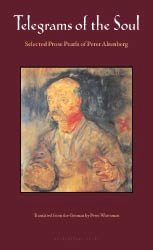
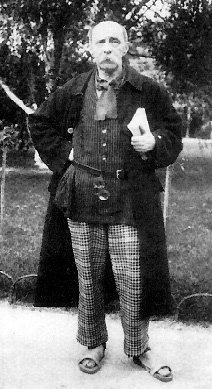
Introducing Peter Altenberg
Peter Altenberg (1859-1919) was the pen name of Richard Englaender. He was the quintessential Viennese bohemian, pioneering a leisurely style of dress, who usually wore sandals and sported a great, bushy mustache (which did not make him look mean at all). His most characteristic writings are short, seemingly spontaneous pieces. Typical is his account of How I Became a Writer. He would have made a perfect blogger.
I first heard of him on the Jack Paar Show, back when I was in high school. One of Paar's regular guests, author Alexander King, a native of Vienna and quite a bohemian himself, often told stories about Altenberg. One of them I have never forgotten:
It seems that Altenberg -- who lived in a hotel room and gave the Cafe Central (a favorite hangout of Vienna's intellectual set) as his official address -- woke up one morning after a night of overindulgence and decided to spend the day in bed. But, just as he was falling back to sleep, he remembered it was the birthday of a woman he very much loved. So he roused himself, got dressed, and went to the florist's, where he bought a large bouquet consisting all different sizes, shades and varieties of yellow flowers, and sent it the woman -- but without a card.
Later that day, he stopped by the woman's house to pay his respects. Only she wasn't home. But her maid told Altenberg about the wonderful bouquet someone had sent the woman. The maid said she just hoped that the bouquet was from Mr. Spellmann, because her mistress was very much in love with Spellmann. Whereupon Altenberg assured her that it was indeed from Spellmann. He knew, he told her, because he had been with Spellmann when he bought it.
Still later in the day, Spellmann dropped by to pay his respects, and the woman showered him with kisses and thank-yous for the wonderful bouquet. Spellmann had no idea what she was talking about, but didn't want to spoil her joy either, so he took the maid aside and asked her about it. The maid told him what Altenberg had said, and Spellmann put two and two together and went out and bought a second bouquet, this one made up of all different sizes and shades and colors of different flowers -- and sent it to the woman with Altenberg's card.
That night, when the woman was retiring, she said to her maid, "You know, I just received another beautiful bouquet, this one from Mr. Altenberg. But you know, I like the other bouquet better, the yellow one, because it was sent by someone who really loves me. A woman can tell such things."
Thanks to Archipelago Books, you can read a representative selection of Altenberg's writings, very nicely translated by Peter Wortsman. It's called Telegrams of the Soul.
I first heard of him on the Jack Paar Show, back when I was in high school. One of Paar's regular guests, author Alexander King, a native of Vienna and quite a bohemian himself, often told stories about Altenberg. One of them I have never forgotten:
It seems that Altenberg -- who lived in a hotel room and gave the Cafe Central (a favorite hangout of Vienna's intellectual set) as his official address -- woke up one morning after a night of overindulgence and decided to spend the day in bed. But, just as he was falling back to sleep, he remembered it was the birthday of a woman he very much loved. So he roused himself, got dressed, and went to the florist's, where he bought a large bouquet consisting all different sizes, shades and varieties of yellow flowers, and sent it the woman -- but without a card.
Later that day, he stopped by the woman's house to pay his respects. Only she wasn't home. But her maid told Altenberg about the wonderful bouquet someone had sent the woman. The maid said she just hoped that the bouquet was from Mr. Spellmann, because her mistress was very much in love with Spellmann. Whereupon Altenberg assured her that it was indeed from Spellmann. He knew, he told her, because he had been with Spellmann when he bought it.
Still later in the day, Spellmann dropped by to pay his respects, and the woman showered him with kisses and thank-yous for the wonderful bouquet. Spellmann had no idea what she was talking about, but didn't want to spoil her joy either, so he took the maid aside and asked her about it. The maid told him what Altenberg had said, and Spellmann put two and two together and went out and bought a second bouquet, this one made up of all different sizes and shades and colors of different flowers -- and sent it to the woman with Altenberg's card.
That night, when the woman was retiring, she said to her maid, "You know, I just received another beautiful bouquet, this one from Mr. Altenberg. But you know, I like the other bouquet better, the yellow one, because it was sent by someone who really loves me. A woman can tell such things."
Thanks to Archipelago Books, you can read a representative selection of Altenberg's writings, very nicely translated by Peter Wortsman. It's called Telegrams of the Soul.
Wednesday, April 27, 2005
Of storage systems and form ...
One of the problems facing anyone who wants to blog is how to find the time. Obviously, successful bloggers have found solutions to that problem. But those of us just starting out have to find our own. Here's mine:
Most days I walk to work. It's a distance of 2.2 miles and takes about 35 minutes. A lot of ideas come to me then -- most of them, naturally, having something to do with my job -- and I've decided to make note of them on this blog when I come in.
The idea that hit me today -- and it hit me, actually, before I even left the house -- is that books, first and foremost, are a storage system. Before we had books, we had scrolls. And now, thanks to computers, we're back scrolling again. But, like a lot of people, I find find scrolling through and reading large chunks of prose on a computer screen tiring. I think that's why blog posts that are short and to the point work better than longer ones.
This made me think that the nature of the storage system must have some bearing on the form of the writing. And it leads me to suspect that a new form of the essay is already evolving out of the practice of blogging. In Vienna, around the turn of the last century, there was a writer whose style was ideally suited to blogging. His name was Peter Altenberg. I'll have more to say about him in a subsequent post.
Most days I walk to work. It's a distance of 2.2 miles and takes about 35 minutes. A lot of ideas come to me then -- most of them, naturally, having something to do with my job -- and I've decided to make note of them on this blog when I come in.
The idea that hit me today -- and it hit me, actually, before I even left the house -- is that books, first and foremost, are a storage system. Before we had books, we had scrolls. And now, thanks to computers, we're back scrolling again. But, like a lot of people, I find find scrolling through and reading large chunks of prose on a computer screen tiring. I think that's why blog posts that are short and to the point work better than longer ones.
This made me think that the nature of the storage system must have some bearing on the form of the writing. And it leads me to suspect that a new form of the essay is already evolving out of the practice of blogging. In Vienna, around the turn of the last century, there was a writer whose style was ideally suited to blogging. His name was Peter Altenberg. I'll have more to say about him in a subsequent post.
Monday, April 25, 2005
An anniversary ...
Walter de la Mare, one of my favorite poets, was born on April 25, 1873. Here's a link to his best-known poem, The Listeners. And here's another, to The Walter de la Mare Society.
Subscribe to:
Posts (Atom)