...Thoughts for the Day.
Regarding the astronauts, though, Glenn notes that the story may not amount to much.

Saturday, July 28, 2007

Friday, July 27, 2007
Poetic lord ...
... Poet of the Week: Fulke Greville. (Hat tip, Dave Lull, who notes:
"His poems make their appeal to the ear and the intellect, not to the inner eye." [Good for those of us with a deficient, or even an absent, inner eye.])
"His poems make their appeal to the ear and the intellect, not to the inner eye." [Good for those of us with a deficient, or even an absent, inner eye.])
Good God ...
... Garrison Keillor seems to be looking poorly: Poem: "The Clasp" .
Check out this item to. Especially, click on the first link, to John Treadwell Nichols:
It's the birthday of John Treadwell Nichols (books by this author), born in Berkeley, California (1940). After traveling in Central America and moving to New Mexico, he decided that he had to write a political novel about the lives of Latin American people. He worked on seven novels that never saw the light of day, and then finally came out with The Milagro Beanfield War (1974), about a poor man who diverts water from an irrigation canal so that he can raise beans to support his family. It was a great success, and Robert Redford made it into a movie.
Check out this item to. Especially, click on the first link, to John Treadwell Nichols:
It's the birthday of John Treadwell Nichols (books by this author), born in Berkeley, California (1940). After traveling in Central America and moving to New Mexico, he decided that he had to write a political novel about the lives of Latin American people. He worked on seven novels that never saw the light of day, and then finally came out with The Milagro Beanfield War (1974), about a poor man who diverts water from an irrigation canal so that he can raise beans to support his family. It was a great success, and Robert Redford made it into a movie.
Good news ...
... About 100 unpublished poems. I am very fond of Mistral's poetry. I wish they had posted some of the photos.
On your mark ...
... Writers in Training. (Hat tip, Rus Bowden.)
I actually don't think it's a good idea to go to school to learn how to write. I think it's best to read a lot and look around you and observe carefully what's going on and then just sit down and write ... and write ... and write.
I actually don't think it's a good idea to go to school to learn how to write. I think it's best to read a lot and look around you and observe carefully what's going on and then just sit down and write ... and write ... and write.
Aha!
... so it turns out he's not friendly to people: Oscar the Serial Killer.
True, Bryan's not the most dispassionate observer in this case, but I think the prima facie evidence is there. (By the way, I rather like cats myself. At least I liked Pandora, who was with me for 20 years and is buried in our garden. I like dogs, too - more than cats, actually. But Pandora was special.)
Let's have a contest ...
... since a number of people have suggested that this shot of me is a worthy subject for a caption contest, I say let rip with your entries. One clarification, though: The photo - as the sharp-eyed Vikram Johri has noted - was taken with Carlin Romano's corner of the book room in the background (Carlin was on vacation at the time, I think). So the clutter is really his. The front of my desk can be seen in the lower lefthand corner of the photo. I'll take a picture of the rest of the room next week and post for the edification of all.
Thursday, July 26, 2007
Legal shenanigans ...
... Carlin Romano's piece on Saira Rao's Chambermaid ( Novel does no honor to judge) has drawn much attention. Here, for instance: Chambermaid: Judge Sloviter Speaks. And here: Chambermaid: For the Record. We'll check for when Carlin responds to their email.
Online poetry alert ...
... the folks at WordFlair have put together an anthology of 50 internet poets: A Bouquet of Poetry.
Words, words, words ...
... Increasing Your Vocabulary.
As Amy notes, these do not seem especially unusual. But it's nice to have them gathered in one place.
As Amy notes, these do not seem especially unusual. But it's nice to have them gathered in one place.
Me and mine ...
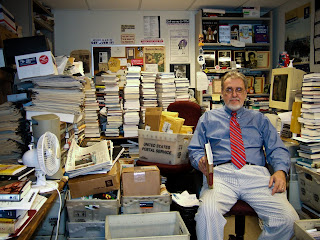
... a shot of yours truly that Andro Linklater took of me when he was at the office for an interview.
What's going on ...
... Shameless has just been to Mysterious Venice, which is where I happen to know Maxine currently is.
The horror, the horror ....
... Tomatoes and Milk.
Apart from Susan's tomato bisque recipe (what I immediately thought of myself) this post includes some of the ost ghastly culinary references imaginable, though it's nice to learn that Bryan and I share a fondness for halibut.
Apart from Susan's tomato bisque recipe (what I immediately thought of myself) this post includes some of the ost ghastly culinary references imaginable, though it's nice to learn that Bryan and I share a fondness for halibut.
Another Lull ...
... though they spell it Llull: Catalan Culture’s Programme for Frankfurt 2007 is presented.
Talk about contrarian ...
... Our Creed and Our Character. (Hat tip, Dave Lull.)
"In Keynes’s haughty disdain can be found the intellectual lineaments of countless subsequent attacks on American imperialism—a point of view that, as Gelernter observes, has lately been embraced by American intellectuals who are as ill at ease with our national religiosity as are their European counterparts. For such religion-hating postmodernists, there can be no salvation without secularism."
Headline of the day ...
... Chief Lies-a-Lot fired.
Glenn agrees and has more.
Glenn agrees and has more.
The comments appended to the Chronicle of Higher Education piece are interesting. Some demonstrate that tenure does not necessarily carry with it a capacity for clear thinking. Churchill falsified his credentials, stole others' intellectual property, and misrepresented still others'. Yet some seem to think that tenure is tenure, by whatever means obtained, and must be respected without furtrher question. The fact is, Churchill is a fraud and, except at being a fraud, an incompetent.


Wednesday, July 25, 2007
Cogito, ergo Gallicus sum
Those cogitating French are all tumulte over their new leaders' attitudes towards thinking. Those leaders apparently think (if that's the word) it's overrated.
An original ...
... for sure: Spiegel Interview with Alexander Solzhenitsyn.
This is interesting: "The February Revolution had deep roots -- I have shown that in 'The Red Wheel.' First among these was the long-term mutual distrust between those in power and the educated society, a bitter distrust that rendered impossible any compromise, any constructive solutions for the state."
This is interesting: "The February Revolution had deep roots -- I have shown that in 'The Red Wheel.' First among these was the long-term mutual distrust between those in power and the educated society, a bitter distrust that rendered impossible any compromise, any constructive solutions for the state."
Tuesday, July 24, 2007
Curiouser and curiouser ...
... The truly miraculous properties of carbon dioxide. (Hat tip, Dave Lull.)
More about truth ...
... Intellectual adolescence. (Hat tip, Dave Lull.)
This covers a wide expanse of nonsense, but I particularly liked this: "Louise Lamphere ... a past president of the American Anthropological Association, claims that there is an 'urgent need' for an 'engaged anthropology,' within which moral commitment trumps impersonal scientific concern ..." Exactly what is her moral certainty grounded in, I wonder.
This covers a wide expanse of nonsense, but I particularly liked this: "Louise Lamphere ... a past president of the American Anthropological Association, claims that there is an 'urgent need' for an 'engaged anthropology,' within which moral commitment trumps impersonal scientific concern ..." Exactly what is her moral certainty grounded in, I wonder.
Monday, July 23, 2007
The endangered book review ...
... Poisoning the Well.
I can't say that I disagree with this exactly - no surprise there, I suppose - but I can't help thinking that abandoning book reviews poses a greater danger to newspapers than it does to reviews or reviewers or literature. Reviewing will continue to take place in some way, shape or form. But there will be one less reason to pick up a newspaper.


An interesting question ...
... What do you give back?
I am myself more in the not-letting-my left-hand-know-what-my-right-is-doing school.
I am myself more in the not-letting-my left-hand-know-what-my-right-is-doing school.
The road to Damascus ...
... musically speaking, that is: From Iggy to Gigli: my journey to the Proms. (Hat tip, Dave Lull.)
Another bad idea ...
... nicely skewered: The Elders Are Coming! (Hat tip, Dave Lull.)
Richard Branson seems to be hell-bent on proving (as if it hadn't been demonstrated often already) that you can make a lot of money and still be a dimwit.
Richard Branson seems to be hell-bent on proving (as if it hadn't been demonstrated often already) that you can make a lot of money and still be a dimwit.
Sunday, July 22, 2007
How science works ...
... and how not: Angier's The Canon and New Atheism at Prosthesis. (Hat tip, Dave Lull.)
In this connection, this is very much worth looking at, since, I gather, it is up for peer review, and it's about soundness of methodology: Global Warming: Forecasts by Scientists versus Scientific Forecasts*.
In this connection, this is very much worth looking at, since, I gather, it is up for peer review, and it's about soundness of methodology: Global Warming: Forecasts by Scientists versus Scientific Forecasts*.
"We have been unable to identify any scientific forecasts to support global
warming. Claims that the Earth will get warmer have no more credence than saying that it will get
colder."
warming. Claims that the Earth will get warmer have no more credence than saying that it will get
colder."
Poetry and madness ...
... hearing voices (speaking in tongues) the poetry of schizophrenia. (Hat tip, Rus Bowden.) I have seen schizophrenia up close. It is a terrible affliction.


Score me skeptical ...
... Bryan Appleyard on psychometric tests: Want a job? Let’s play mind games.
I'm not sure I'm quite as skeptical this, however:
I'm not sure I'm quite as skeptical this, however:
Who are you?
Never been asked, but if it ever is, answer: “I don’t know and, more to the point, you never will.”
I know who I am. I just can't say it in so many words.
My two cents ...
... Dan Green agrees and disagrees with Eliza:End of Week Pronouncements. (Hat tip, Dave Lull.)
I think Eliza's point is simply that it is better to read than not and that we ought not to be taken to task because what we read doesn't measure up to someone else's high-falutin' standard. Reading is a co-creative act. A mediocre book may well stimulate a first-rate imaginative response in a reader whose imagination might well not be sparked by Swann's Way. So what?
I think Eliza's point is simply that it is better to read than not and that we ought not to be taken to task because what we read doesn't measure up to someone else's high-falutin' standard. Reading is a co-creative act. A mediocre book may well stimulate a first-rate imaginative response in a reader whose imagination might well not be sparked by Swann's Way. So what?
A model discussion ...
... Keen vs. Weinberger. (Hat tip, Dave Lull.)
I'm mostly on Weinberger's side in this, but I applaud both for a thorough and thoroughly civil dialogue.
I'm mostly on Weinberger's side in this, but I applaud both for a thorough and thoroughly civil dialogue.
Today's Inquirer reviews ...
... first, the biggie - Susan Balée just loved the new and final Harry Potter: Dark and witty, 'Potter' bows at its best. (She's not the only one: 759 Pages, No Waiting.)
... Martha Woodall is somewhat disappointed in Elizabeth Berg's latest: WWII story engaging, lacks depth.
... Steve Weinberg thinks Hamlin Garland's A Son of the Middle Border still holds up: Memoir a classic in 1917, still so in reissue.
... Chris Patsilelis likes The Pentagon: Seat of U.S. military might.
... Sarah Weinman is of two minds about the new Ruth Rendell: Another entry from Ruth Rendell
... Katie Haegele is much taken with Cecil Castellucci's Beige: Young Adult Reader | How she spent vacation: 21/2 weeks with punk-rock Dad.
... and here's more on Pearl Buck: Scripting a Pearl Buck revival.
... Martha Woodall is somewhat disappointed in Elizabeth Berg's latest: WWII story engaging, lacks depth.
... Steve Weinberg thinks Hamlin Garland's A Son of the Middle Border still holds up: Memoir a classic in 1917, still so in reissue.
... Chris Patsilelis likes The Pentagon: Seat of U.S. military might.
... Sarah Weinman is of two minds about the new Ruth Rendell: Another entry from Ruth Rendell
... Katie Haegele is much taken with Cecil Castellucci's Beige: Young Adult Reader | How she spent vacation: 21/2 weeks with punk-rock Dad.
... and here's more on Pearl Buck: Scripting a Pearl Buck revival.
When stories clash ...
... it's good know they're all true (see previous post):Both New Republic and Weekly Standard Missing Elementary Journalism.
Tom Lipscomb, by the way, who reviews for The Inquirer, is as sharp a journalist as you are likley to find on this planet. I'll have to ask him what he thinks of Ms. Trunk's epistemelogical insights.
Tom Lipscomb, by the way, who reviews for The Inquirer, is as sharp a journalist as you are likley to find on this planet. I'll have to ask him what he thinks of Ms. Trunk's epistemelogical insights.
There is no truth ...
... only autobiography ... or something like that. And so: It Doesn't Matter that Journalists Misquote Everyone.
"Journalists who think they are telling 'the truth' don't understand the truth. We each have our own truth." Gee, I never knew that. And I've always taken great pains to make sure I quoted people accurately. I also always took pains to make sure what was quoted was placed in context. I even thought I was tring to tell someone else's story, and not just my own, over and over again, all the time. Silly me. Not surprising, though, since I "don't understand that the truth." I thought it had something to do with the conformity of the mind to reality. Obviously, though, it's just the way people see things - nobody's right and, of course, nobody's wrong.
Saturday, July 21, 2007
Friday, July 20, 2007
A must read ...
... The Banality of Evil 2. The must read is the review of Bryan's that he links to near the end of the post. Note that at no point does he divulge any of the sensational (and presumably gruesome) details. This is a well-nigh perfect book review, filled with money quotes, though I will cite only one: "in the last analysis, the evil act is a decision, even when taken by children. No causal chain, however plausible, will account for that moment of dreadful freedom when some do and some do not. The only coherent and humane account we have of such decisions is the Christian doctrine of original sin which says, not that people are evil, but rather that there is evil in all of us. This is humane because it provides sympathetic insight rather than dubious chains of quasi-scientific causality."


This is the same effect Harry Potter will have on bookstores worldwide at midnight tonight.
Although this sounds as if it should have come from the Farmer's Almanac, this compelling bit of history comes from today's Writer's Almanac:
It was on this day in 1875 that the largest recorded swarm of locusts in American history descended upon the Great Plains. It was a swarm about 1,800 miles long, 110 miles wide, from Canada down to Texas. North America was home to the most numerous species of locust on earth, the Rocky Mountain locust. At the height of their population, their total mass was equivalent to the 60 million bison that had inhabited the West. The Rocky Mountain locust is believed to have been the most common macroscopic creature of any kind ever to inhabit the planet.
Swarms would occur once every seven to twelve years, emerging from river valleys in the Rockies, sweeping east across the country. The size of the swarms tended to grow when there was less rain--and the West had been going through a drought since 1873. Farmers just east of the Rockies began to see a cloud approaching from the west. It was glinting around the edges where the locust wings caught the light of the sun.
People said the locusts descended like a driving snow in winter. They covered everything in their path. They sounded like thunder or a train and blanketed the ground, nearly a foot deep. Trees bent over with the weight of them. They ate nearly every living piece of vegetation in their path. They ate harnesses off horses and the bark of trees, curtains, clothing that was hung out on laundry lines. They chewed on the handles of farm tools and fence posts and railings. Some farmers tried to scare away the locusts by running into the swarm, and they had their clothes eaten right off their bodies.
Similar swarms occurred in the following years. The farmers became desperate. But by the mid 1880s, the rains had returned, and the swarms died down. Within a few decades, the Rocky Mountain locusts were believed to be extinct. The last two live specimens were collected in 1902, and they're now stored at the Smithsonian.
It was on this day in 1875 that the largest recorded swarm of locusts in American history descended upon the Great Plains. It was a swarm about 1,800 miles long, 110 miles wide, from Canada down to Texas. North America was home to the most numerous species of locust on earth, the Rocky Mountain locust. At the height of their population, their total mass was equivalent to the 60 million bison that had inhabited the West. The Rocky Mountain locust is believed to have been the most common macroscopic creature of any kind ever to inhabit the planet.
Swarms would occur once every seven to twelve years, emerging from river valleys in the Rockies, sweeping east across the country. The size of the swarms tended to grow when there was less rain--and the West had been going through a drought since 1873. Farmers just east of the Rockies began to see a cloud approaching from the west. It was glinting around the edges where the locust wings caught the light of the sun.
People said the locusts descended like a driving snow in winter. They covered everything in their path. They sounded like thunder or a train and blanketed the ground, nearly a foot deep. Trees bent over with the weight of them. They ate nearly every living piece of vegetation in their path. They ate harnesses off horses and the bark of trees, curtains, clothing that was hung out on laundry lines. They chewed on the handles of farm tools and fence posts and railings. Some farmers tried to scare away the locusts by running into the swarm, and they had their clothes eaten right off their bodies.
Similar swarms occurred in the following years. The farmers became desperate. But by the mid 1880s, the rains had returned, and the swarms died down. Within a few decades, the Rocky Mountain locusts were believed to be extinct. The last two live specimens were collected in 1902, and they're now stored at the Smithsonian.
Thursday, July 19, 2007
Whew!
... I am back from the hospital - and so is Debbie. Her surgery went extraordinarily well this morning. A growth, apparently benign, was removed and she didn't even have to spend the night at the hospital. I cannot express what a relief this is. Thanks to all who sent best wishes and offered up prayers. They were all deeply appreciated.
How to appear cultured
Speaking of book reviews, Dave Lull (when the credits roll at the end of today, his will be the only name on them) points out this amusing one about a non-reading French literature professor.
If you're not a classicist.........
.........this review will make you wish you were one. I loved Latin in school and would have liked to have been a classicist myself, had I not become a smooth-talking drifter (which has its own consolations).
In the spirit of vacation travel ...
... comes this article, discovered via Bookninja, which, I have to admit, I completely understand. While I wouldn't say I spend half my travel time in bookstores, there's something romantic about browsing stories in some far-away place. This means, though, that the dispute over the enjoyment - added weight ratio is not uncommon amongst traveling family members.
Oh dear ...
Applause to Nige for pointing out this article and thereby completely undermining my faith in humanity.
Hooray for Inquirer Books!
What can I say? I find new reviews exciting.
Susan Balée appreciates the animals in Jon Katz's Dog Days: Sometimes you feel like a mutt . . . so fetch this
Susan Balée appreciates the animals in Jon Katz's Dog Days: Sometimes you feel like a mutt . . . so fetch this
The trouble with the media (cont'd.) ...
... or Mondern Journalism in a Nutshell.
Geez, what a dim-witted argument to advance.
Then, there's this: All journalism, all the time.
Geez, what a dim-witted argument to advance.
Then, there's this: All journalism, all the time.
Wednesday, July 18, 2007
Score one for Bryan ...
... I think this is best refutation of Hannah Arendt's "banality of evil" thesis that I have read: Potter 3: Amanda, Arendt and The Banality of Evil.
In fairness to Arendt, though, I think she was trying to dispel the notion that there is always something slightly glamourous about evildoers - a la Mephistopheles, or Milton's Satan. On the contrary: The perpetrators of evil are, as often as not, dull, uninteresting brutes.
In fairness to Arendt, though, I think she was trying to dispel the notion that there is always something slightly glamourous about evildoers - a la Mephistopheles, or Milton's Satan. On the contrary: The perpetrators of evil are, as often as not, dull, uninteresting brutes.
Where I am ...
... I am back from a week in the cabin we rent outside Tunkhannock. But I'm not back in the office until a week from today. So blogging will be sporadic until then. Tomorrow there won't be any at all, because my wife is having surgery and I will be at the hospital all day.
Serves them right ...
... Last Harry Potter leaks online.
This news fills me with the wonderful thrill of schadenfreude. Allow me to explain.
A few years ago, at BookExpo America, I attended a panel discussion regarding embargo agreements. Those on the panel proudly declared that they never had and never would sign an agreement to honor a book embargo (i.e., promising to publish nothing about said book until the date of publication). I found the whole business sufficatingly sanctimonious. I had, have, and will continue to sign such agreements. Why? Because it's in the interest of The Inquirer's readers, that's why. I'm in the business of getting them news about books as expeditiously as I can, not in the business of being holier than thou.
But the lengths to which publishers Bloomsbury and Scholastic have gone to prevent anyone from knowing anything about the latest Harry Potter book until the precise moment the publishers allow them to has reeked of arrogance. No review was ever going to give away the ending. And the publishers know as well as I do that the New York Times will get a copy of the book beforehand. They always do. They got a copy of the last one. So refusing to grant other papers any pre-publication access to the book gives the Times an advantage by default. Quite frankly, as a representative of one of those papers, I resent that.
Moreover, there is something inherently offensive about a publisher going to such extremes to prevent information from becoming public. I would have have gladly signed an embargo agreement - and I would have honored it to the letter, as I always have. Bloomsbury and Scholastic would have earned the good will born of civility and cordiality. As it is, I have to review the Potter book. But when something else comes along that Bloomsbury or Scholastic would like special attention paid to, I suspect I'm going to suddenly discover my Missouri roots.
So I'm glad, really glad, that all their security measures have come to nought. It's what they ought to have come to.
This news fills me with the wonderful thrill of schadenfreude. Allow me to explain.
A few years ago, at BookExpo America, I attended a panel discussion regarding embargo agreements. Those on the panel proudly declared that they never had and never would sign an agreement to honor a book embargo (i.e., promising to publish nothing about said book until the date of publication). I found the whole business sufficatingly sanctimonious. I had, have, and will continue to sign such agreements. Why? Because it's in the interest of The Inquirer's readers, that's why. I'm in the business of getting them news about books as expeditiously as I can, not in the business of being holier than thou.
But the lengths to which publishers Bloomsbury and Scholastic have gone to prevent anyone from knowing anything about the latest Harry Potter book until the precise moment the publishers allow them to has reeked of arrogance. No review was ever going to give away the ending. And the publishers know as well as I do that the New York Times will get a copy of the book beforehand. They always do. They got a copy of the last one. So refusing to grant other papers any pre-publication access to the book gives the Times an advantage by default. Quite frankly, as a representative of one of those papers, I resent that.
Moreover, there is something inherently offensive about a publisher going to such extremes to prevent information from becoming public. I would have have gladly signed an embargo agreement - and I would have honored it to the letter, as I always have. Bloomsbury and Scholastic would have earned the good will born of civility and cordiality. As it is, I have to review the Potter book. But when something else comes along that Bloomsbury or Scholastic would like special attention paid to, I suspect I'm going to suddenly discover my Missouri roots.
So I'm glad, really glad, that all their security measures have come to nought. It's what they ought to have come to.
Consider the comma;
OK, it's not quite as thirst-quenching but, the old Coca Cola refrain notwithstanding, that humble punctuation mark really is the pause that refreshes.
Summertime and the livin' is, well, not so easy.
If anyone out there is a meteorologist (even an amateur one if there is such a thing), an answer please.
If the Iraqi parliament is taking off for a month because "it's 135 degrees in Iraq in August", how cool does it get on September 1?
If the Iraqi parliament is taking off for a month because "it's 135 degrees in Iraq in August", how cool does it get on September 1?
William Makepeace Thackeray
It's his birthday today (1811) and he wrote "There are a thousand thoughts lying within a man that he does not know until he takes up a pen to write."
And that thought itself may have been one of them.
Hat tip for the birthday tip to The Writer's Almanac.
And that thought itself may have been one of them.
Hat tip for the birthday tip to The Writer's Almanac.
Great minds ...
... my colleague Carlin Romano and I are, once again, on the same page: If We Don't Call Them Names, the Terrorists Win.
Should Ayman al-Zawahri, deputy head of Al Qaeda, be the only "leader" quoted making moral judgments — that Arab regimes are "corrupt" — in a week of terrorist incidents? Why do media parrot this moral irresponsibility, as in The Boston Globe's post-Glasgow editorial that the terrorist threat can "be countered by means of sound intelligence, conventional police work, legal adaptations that do not create a law-free zone, and leadership that distinguishes law-abiding communities from the crazed Islamist ideologues that prey upon them"?
Tuesday, July 17, 2007
Before there was Diana ...
... there was Margaret Rose: Princess Margaret: A Life Unravelled.
But, speaking of Diana, here's Tina Brown and The Diana Chronicles.
But, speaking of Diana, here's Tina Brown and The Diana Chronicles.
Zut alors!
Pegasus Books has announced it will publish in October a new (well, new-ish) novel by Alexandre Dumas. Let's just call it recently re-discovered. It's only about 150 years-old.
Inquirer alum, Tim Weiner
..........and Pulitzer Prize winner while here, has written a history of the CIA. Historian Michael Beschloss finds much to admire in it. Other reviews can be found here, here and here.
Henry James in Paris
He probably loved it there. As Steve Martin has pointed out, the French have a word for everything.
Winning poetry ...
... from Mike Allen (whose Strange Wisdoms of the Dead I reviewed last year): 2007 Rhysling Awards.
Here and here are two YouTube clips of The Journey to Kalish. (Hat Tip, Laurie Mason.)
Here and here are two YouTube clips of The Journey to Kalish. (Hat Tip, Laurie Mason.)
In the Inquirer Books world ...
... Charles Desnoyers explores Colin Thubron's latest: 'Silk Road' traces links between empires
Additionally, Thubron will be speaking tonight at 7 p.m. at the Central Library of the Free Library of Philadelphia.
Additionally, Thubron will be speaking tonight at 7 p.m. at the Central Library of the Free Library of Philadelphia.
Monday, July 16, 2007
No Harry Potter trickle-down
Despite - and here some religious fundamentalists may be right - ungodly sales figures, the boy wizard doesn't deliver much magic to booksellers.
A room with not much of a view
Here's a writer's room in which you'd not likely be distracted (unless it's by the chair you're sitting in).
Thanks to Dave for practically all of today's postings.
Thanks to Dave for practically all of today's postings.
You didn't want get on the wrong side of A.E. Housman
.....especially if he got out of the wrong side of the bed that day.
Media habits of one highly effective librarian
You'd think the Librarian of Congress must have enough information to deal with, but noooooooo! He's always trawling for more.
And I think I read somewhere that when he isn't shushing people at the library, he blogs 10 or 12 hours a day too.
And I think I read somewhere that when he isn't shushing people at the library, he blogs 10 or 12 hours a day too.
Subscribe to:
Posts (Atom)